Skip to Content

Category Archives: Plastic mould steel

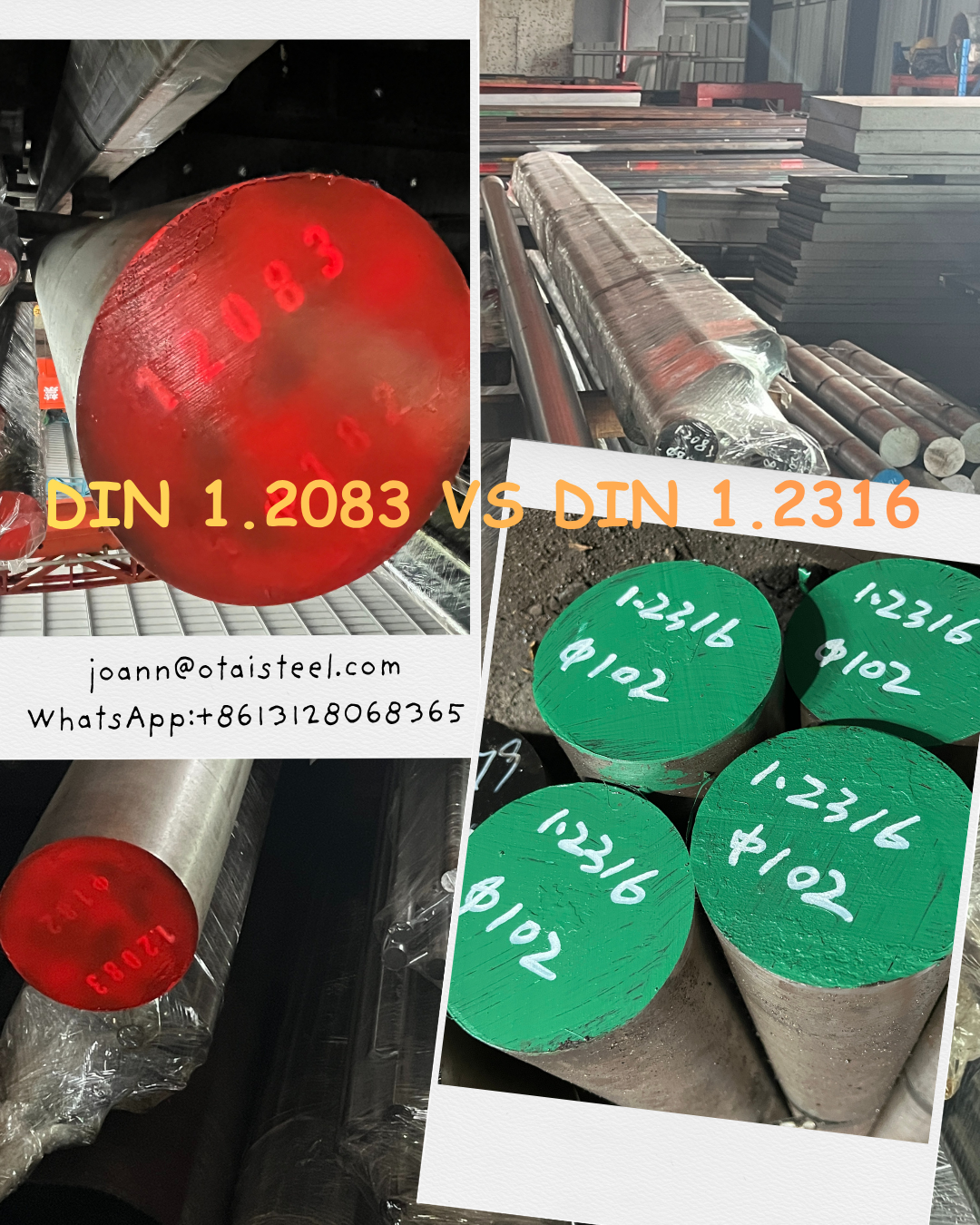
DIN 1.2083 vs DIN 1.2316: Which Stainless Mold Steel Better?

Let me ask you a straight question: Are you overpaying for corrosion protection you don’t need—or under-buying and risking mold failure?

That’s the real battle between DIN 1.2083 and DIN 1.2316. Both are stainless mold steels. Both resist rust. But they are not twins—more like cousins with different personalities.

At Dongguan Otai Special Steel, we see customers hesitate between these two every single week. So let me cut through the confusion. Here is the honest, side-by-side comparison.

Quick Overview: DIN 1.2083 vs DIN 1.2316

Feature DIN 1.2083  DIN 1.2316
Common name X42Cr13 (basic stainless mold steel) GX42Cr13 (modified with molybdenum)
AISI equivalent 420 420 modified (with Mo)
Primary strength Good corrosion resistance + high hardness Excellent corrosion resistance + better polish retention
Typical hardness (HRC) 48 – 52 45 – 50 (slightly softer)
Molybdenum (Mo) None 0.80 – 1.20%
Relative cost Lower Higher (approx. 30–50% more)

Chemical composition compare

Both grades contain high chromium for rust protection. But DIN 1.2316 adds molybdenum. That single change shifts the battlefield entirely.DIN 1.2083 steel-Otai

Element  DIN 1.2083 DIN 1.2316
Carbon (C) 0.38 – 0.42 0.33 – 0.43
Chromium (Cr) 12.0 – 14.0 15.0 – 17.0
Molybdenum (Mo) 0.80 – 1.20
Manganese (Mn) ≤ 1.00 ≤ 1.00
Silicon (Si) ≤ 1.00 ≤ 1.00

Think of molybdenum as the bodyguard of the steel. It fights off pitting corrosion from acidic gases (like PVC or POM) and chloride ions. 1.2083 has no bodyguard—just a good raincoat.

Corrosion Comparison: DIN 1.2083 vs DIN 1.2316

Here’s the short answer: Both resist rust. But 1.2316 fights harder, especially in aggressive environments.

Think of it this way:

  • 1.2083 = A good raincoat. Fine for a shower.

  • 1.2316 = A full storm jacket with a hood. Better for a downpour.

Why the difference? It comes down to chemistry. Let me show you.

Property 1.2083 1.2316 What It Means for You
Chromium (Cr) content 12.0 – 14.0% 15.0 – 17.0% More chromium = stronger passive oxide layer = better rust protection.
Molybdenum (Mo) content None (0%) 0.80 – 1.20% Mo fights pitting corrosion from chlorides and acidic gases. 1.2083 lacks this shield.
Carbon content 0.38 – 0.42% 0.33 – 0.43% Similar hardness potential.
Resistance to humid air Good Excellent 1.2083 works fine in dry workshops. 1.2316 handles tropical storage better.
Resistance to PVC / flame-retardant gases Moderate Very good Both resist, but 1.2316 lasts longer before surface etching appears.
Resistance to salt spray / brine Poor Moderate Don’t use 1.2083 near seawater. 1.2316 buys you time, but still not marine grade.
Resistance to acidic condensation (e.g., POM / acetal) Moderate Good 1.2316 is preferred for high-cavitation molds processing aggressive polymers.
Polished surface durability in service Good – may stain over time Very good – stays cleaner longer Mirror-polished 1.2316 resists “blooming” (micro-rust spots) better.

The Practical Bottom Line

Application Scenario Recommended Grade Why?
Standard plastics (ABS, PP, PE, PS) 1.2083 (cost-effective) No need to overpay. 1.2083 handles normal humidity fine.
PVC, POM, flame-retardant materials 1.2316  Aggressive gases will eventually stain 1.2083. 1.2316 delays that by years.
Medical or food-contact molds Either, but 1.2316 preferred for long runs Hygiene demands no rust. 1.2316 adds insurance.
Molds stored in humid environments 1.2316 1.2083 can develop light surface rust if stored poorly. 1.2316 is more forgiving.
Budget-limited projects 1.2083 You get 80% of the corrosion performance at ~60-70% of the cost.

Mechanical & Physical 

Stronger doesn’t always mean better. Let me show you the trade-offs.

Property 1.2083 1.2316
Max hardness (HRC) 52 50 (slightly lower)
Wear resistance Higher Moderate (softer matrix)
Toughness Moderate (more brittle at high hardness) Better (thanks to lower carbon + Mo)
Polishability Good (mirror possible) Very good (fewer inclusions)
Thermal conductivity ~24 W/(m·K) ~22 W/(m·K) (slightly slower cooling)

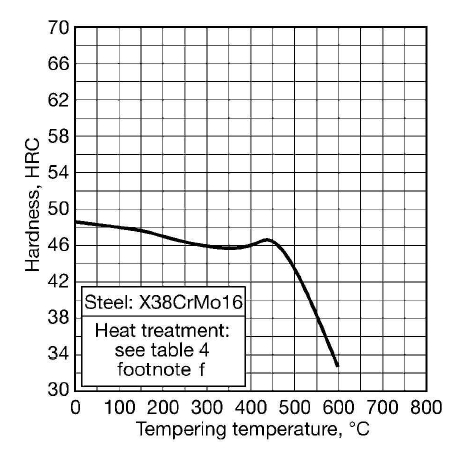
Hardness -tempering temperature curves-OTAI

So 1.2083 gets harder and resists abrasion better. 1.2316 is tougher and less likely to crack under impact.

Application Guide: Which One Do You Actually Need?

Let me save you time and money.

Choose DIN 1.2083 if:

  • Your workshop stays dry and climate-controlled.

  • You process standard plastics (ABS, PP, PE, PS).

  • You need maximum hardness and wear resistance.

  • Your budget is tight.

  • Mold life requirement is under 500,000 shots.

Choose DIN 1.2316 if:

  • You run PVC, POM, or flame-retardant plastics.

  • Your factory or storage area has high humidity.

  • You want longer maintenance intervals (less polishing/staining).

  • The mold must stay mirror-bright for years.

  • You can accept slightly lower hardness for better toughness.

Price vs. Value

1.2316 typically costs 30–50% more than 1.2083 per kilogram. Is it worth it? That depends entirely on your application.

Ask yourself these two questions:

  1. How much would one rust-related mold failure cost you in downtime?

  2. How many production cycles do you need before the next maintenance?

If the answer to question #1 is “thousands of dollars,” buy 1.2316.

If you need 2 million shots from a PVC mold, 1.2316 pays for itself.

If you run ABS in a clean room? 1.2083 is your smart, economical choice.

Final Verdict: No Absolute Winner—Only the Right Fit

I won’t tell you one grade always beats the other. That would be dishonest.

  • 1.2083 wins on: Hardness, wear resistance, and price.

  • 1.2316 wins on: Corrosion resistance, toughness, and polish durability.

So here’s my closing question for you: What environment will your mold live in, and what plastic will it digest?

Answer those two questions honestly, and the choice between 1.2083 and 1.2316 becomes crystal clear.


Need help deciding? At Dongguan Otai Special Steel, we supply both grades in rounds, flats, and plates—cut to size, heat-treated if needed. Contact us with your application details, and we’ll recommend the grade that saves you money without cutting corners.


0 0 Continue Reading →

DIN 1.2083 /420 /SUS420J2/4Cr13/X42Cr13 Steel

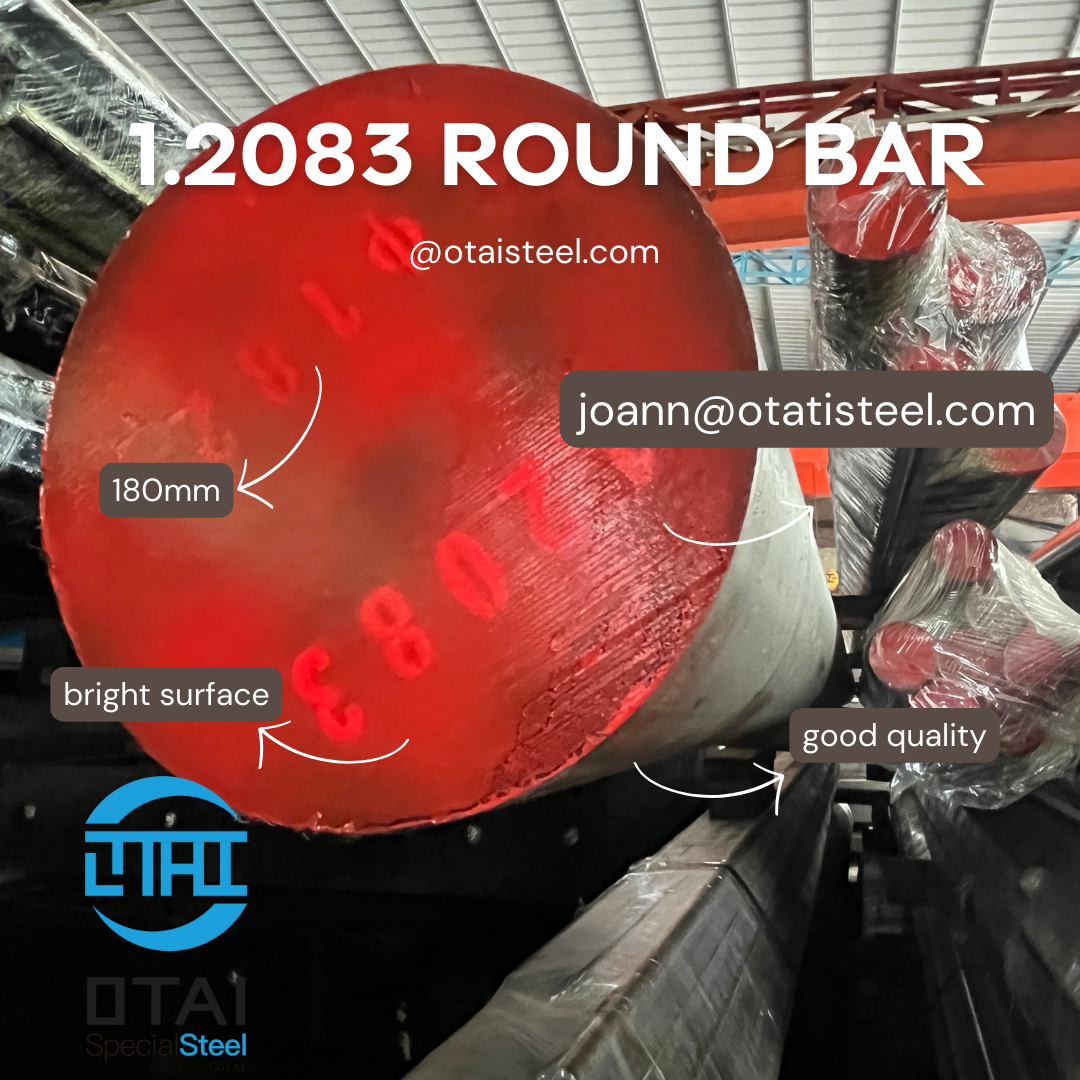
Have you ever watched a stainless steel kitchen knife resist rust after hundreds of washes? That’s the kind of reliability we build into 1.2083 steel. At Dongguan Otai Special Steel, we see this material as the bodyguard of the plastics industry—tough, clean, and ready for harsh conditions.

Let’s cut to the chase. DIN 1.2083 is a martensitic stainless mold steel, widely known as the go-to choice for processing corrosive plastics. But what exactly makes it so special? Think of it as the gym trainer of steel grades: high hardness, good wear resistance, and outstanding resistance to acidic byproducts.

In simple terms,DIN 1.2083 is the German DIN standard ISO EN 4957  steel grade. It is a stainless and mold steel . Globally, you might hear it called by different names:

Standard Equivalent Grade
DIN (ISO EN 4957) 1.2083
AISI (ASTM A681) 420
JIS (Japan) SUS420J2
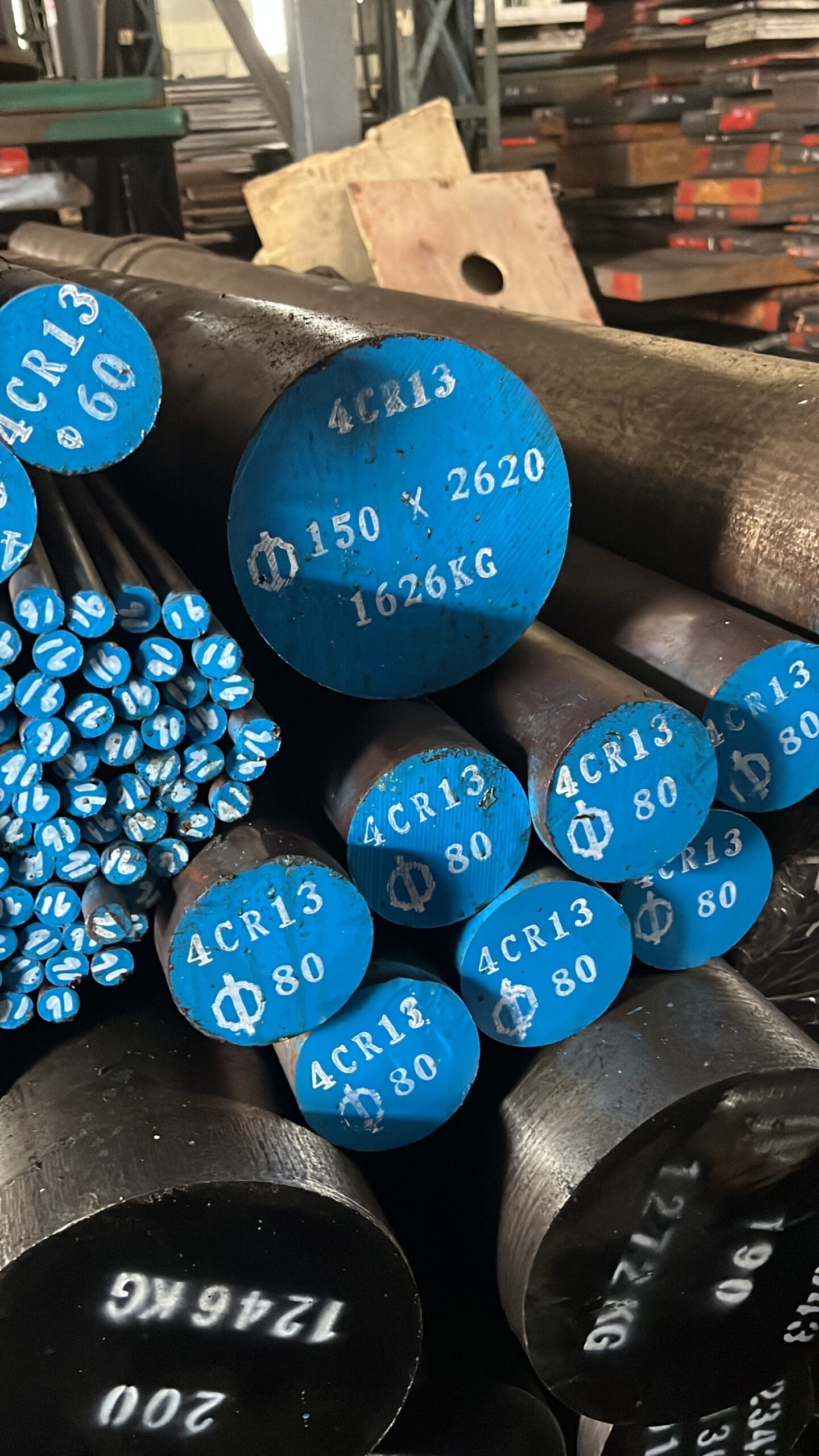
GB (China) 4Cr13
EN (Europe) X42Cr13

Chemical Composition of 1.2083 steel and it’s equivalent grade

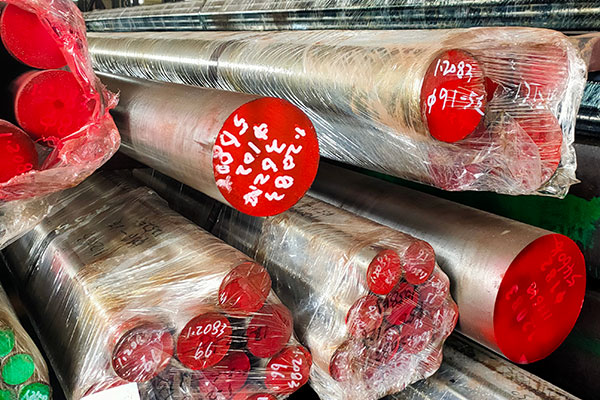
Why does it fight rust so well? Let’s look at its DNA—the chemical composition. Every element plays a role, like musicians in a band.1.2083 steel round bar -Otai

Element 1.2083 (DIN) AISI 420 (USA) SUS420J2 (Japan) 4Cr13 (China)
Carbon (C) 0.38 – 0.42 0.36 – 0.42 0.36 – 0.42 0.36 – 0.45
Chromium (Cr) 12.0 – 14.0 12.0 – 14.0 12.0 – 14.0 12.0 – 14.0
Manganese (Mn) ≤ 1.00 ≤ 1.00 ≤ 1.00 ≤ 0.80
Silicon (Si) ≤ 1.00 ≤ 1.00 ≤ 1.00 ≤ 0.60
Phosphorus (P) ≤ 0.03 ≤ 0.04 ≤ 0.04 ≤ 0.03
Sulfur (S) ≤ 0.03 ≤ 0.03 ≤ 0.03 ≤ 0.03

Mechanical Properties (How It Behaves Under Load)

Property Value (Annealed) Value (Hardened & Tempered)
Hardness 210 – 245 HB 48 – 52 HRC
Tensile Strength, Rm ~ 750 – 850 MPa ~ 1800 – 2100 MPa
Yield Strength, Rp0.2 ~ 450 – 550 MPa ~ 1400 – 1700 MPa
Elongation at Break ~ 12 – 15% ~ 2 – 4%
Impact Toughness (KV) ~ 20 – 25 J ~ 8 – 12 J
Young’s Modulus (Elasticity) 215 GPa (both conditions) 215 GPa (both conditions)

Here’s the trade-off: When you harden DIN 1.2083 , it becomes incredibly strong—like turning soft clay into ceramic tile. But you lose ductility. That’s perfectly fine for molds. Molds don’t bend; they resist wear and pressure.

Physical Properties (The Hidden Constants)

These numbers rarely change with heat treatment. They are the steel’s fingerprint—essential if you’re simulating cooling rates, ejection pin friction, or cycle times.

Physical Property Value Why It Matters to You
Density 7.70 – 7.75 g/cm³ Weight calculation for large mold bases. A 100 kg block? Now you know exactly.
Thermal Conductivity ~ 24 W/(m·K) at 20°C Lower than carbon mold steel. Means slower cooling in the mold. Plan your cycle time accordingly.
Specific Heat Capacity ~ 460 J/(kg·K) How much energy it takes to heat the mold. Important for preheating calculations.
Electrical Resistivity ~ 0.55 µΩ·m Not for electrical parts—but useful for EDM (electrical discharge machining) planning.
Coefficient of Thermal Expansion ~ 10.5 × 10⁻⁶ /K (20–200°C) The steel grows when hot. Account for this in tight ejection systems.
Magnetic Properties Ferromagnetic (magnetic) Yes, it sticks to a magnet. That helps with handling and clamping.

Where Should You Use DIN 1.2083 ? (Applications)

Here’s where this steel truly shines. It’s not for heavy-impact parts like a hammer—but for precision, wet, or acidic environments? Absolutely.

  • Molds for corrosive plastics – PVC, POM, and flame-retardant materials (they release aggressive gases).

  • Medical equipment molds – Because hygiene and rust-resistance are non-negotiable.

  • Food-contact molds – Think yogurt cups, bottle caps, and kitchenware.

  • Injection nozzles and extrusion screws – Where wear meets acid.

  • Optical lens molds – Thanks to its superior polishability.

Still wondering: Can I use standard tool steel here instead? You could… but expect rust spots within weeks. That’s like using a paper umbrella in a typhoon.

DIN 1.2083 Available Sizes from Otai Special Steel

We stock 1.2083 in multiple forms to save you time on machining:

Form Size Range
Round bars Diameter 10 mm – 600 mm
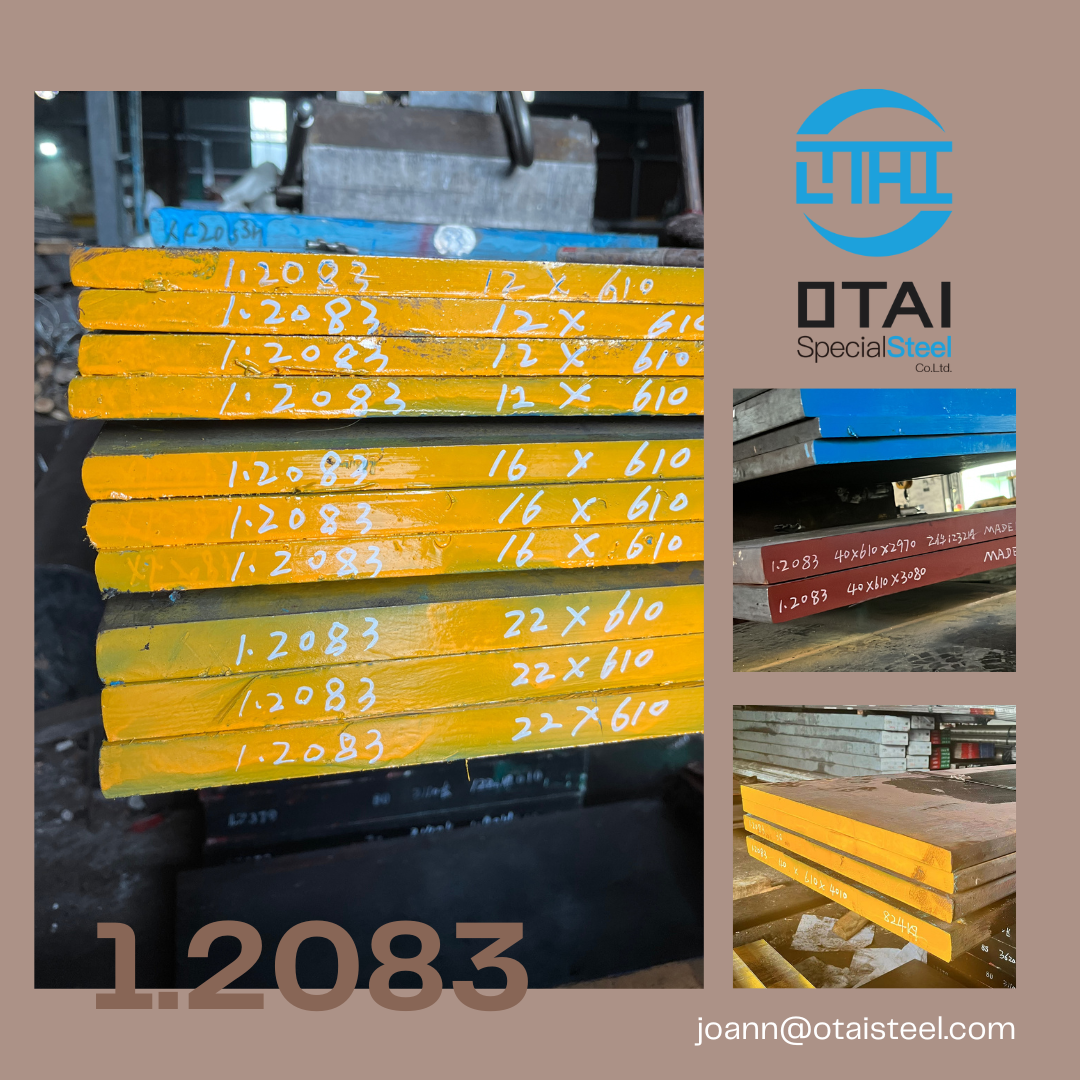
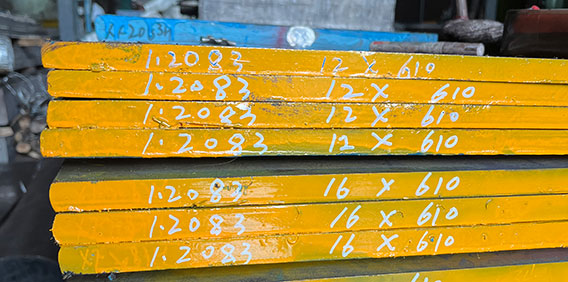
Flat bars Thickness 20 mm – 300 mm × Width up to 810 mm
Plates 20 mm – 200 mm thick × 200 mm – 810 mm wide
Blocks Custom-cut to your CAD dimensions

DIN 1.2083 steel-Otai

Need a specific length? We cut to order—no waste, no waiting.

Price & Cost Considerations

Let’s talk money honestly. 1.2083 is mid-priced in the mold steel family. It costs more than regular mould steel (like 1.2311) but significantly less than high-performance powder metallurgy steels (like 1.2083 VICTORY ESR).

  • Budget range: ~1.8–3.5 USD per kg, depending on size, quantity, and heat treatment.

  • Value tip: For large molds, we recommend ESR (Electro Slag Remelting) grade—higher cost but fewer inclusions and better mirror polish.

Think of it this way: Standard 1.2083 is a reliable sedan. ESR version is a luxury sports car. Both drive; one just handles corners better.

Why Buy DIN 1.2083 from Dongguan Otai Special Steel?

Because we don’t just sell steel—we solve problems. Every batch comes with a mill certificate. We offer cutting, heat treatment (pre-hardening to 280-320 HB or full hard to 50 HRC), and delivery worldwide from our Dongguan warehouse.

One final question: Is your current mold failing due to rust or poor polish? Then why keep patching the problem when 1.2083 can erase it?

Ready to upgrade? Contact Otai Special Steel today—we’ll help you choose the right size, condition, and price for your next precision mold project.


0 0 Continue Reading →

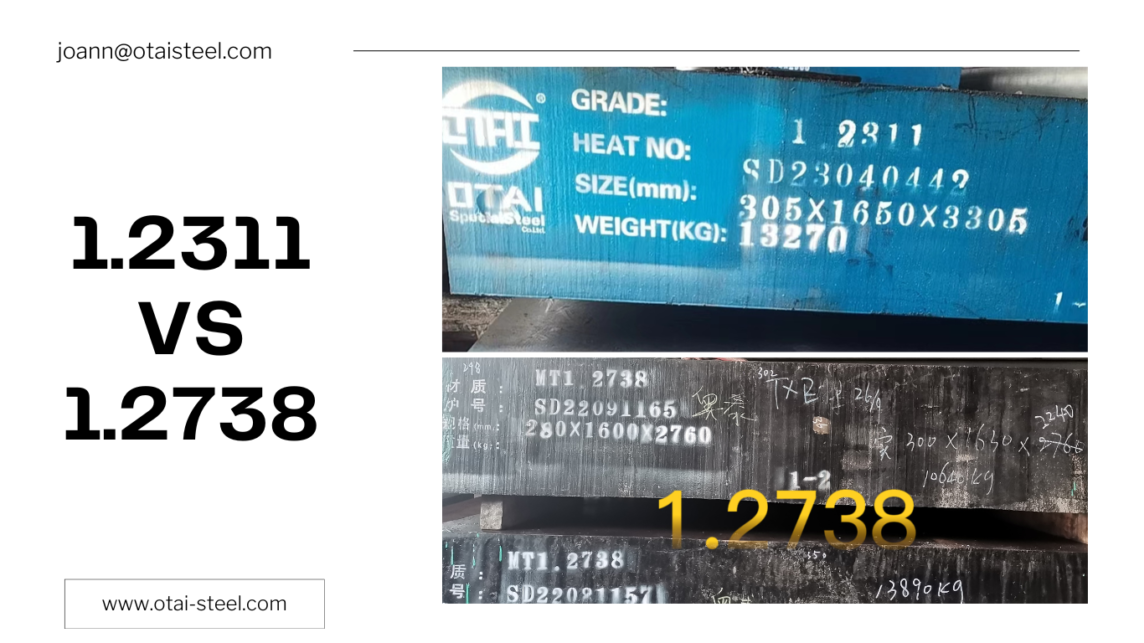
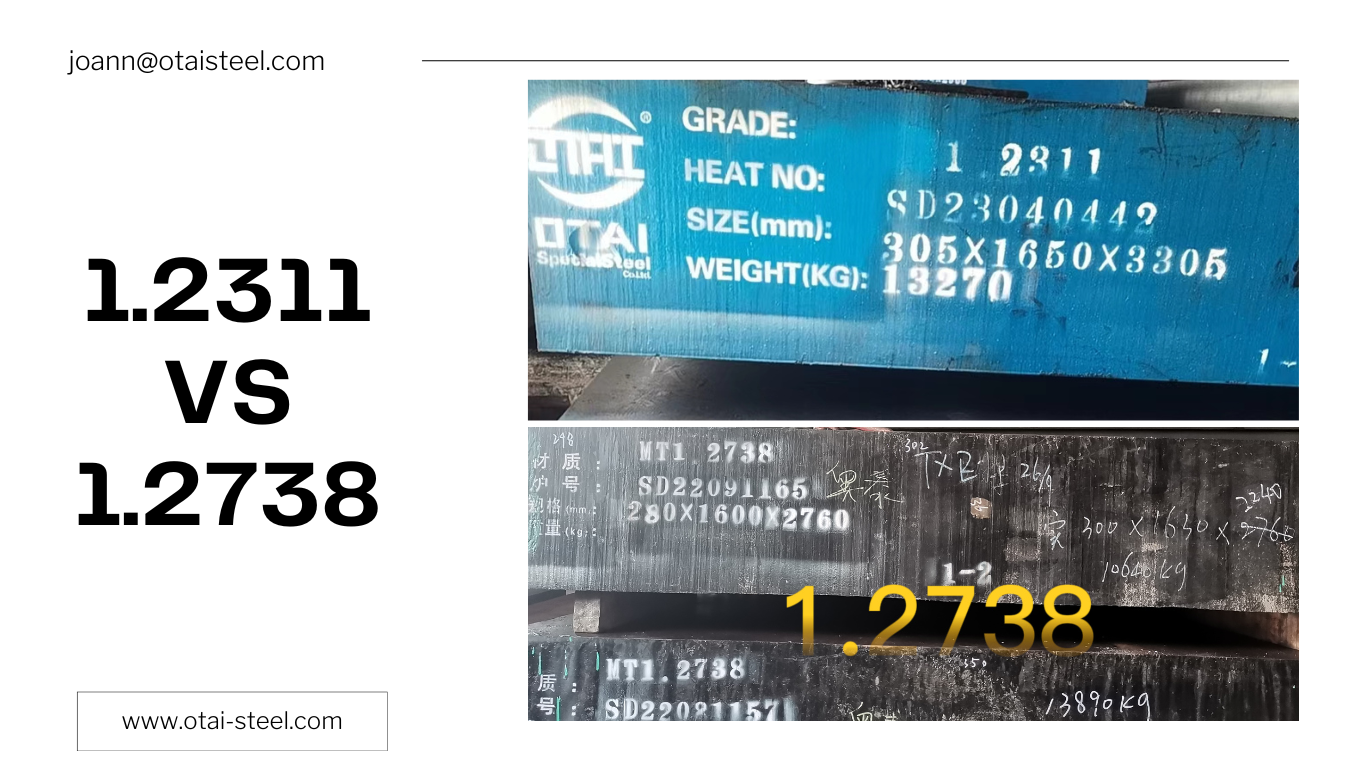
Comparing 1.2311 VS 1.2738 Steel for Mould Making

When we talk to  choosing the right steel for mould making, the most important is consider the precision and performance . Two popular options of mould steel are 1.2311 and 1.2738 steel. In this article, we’ll  analyzes from the chemical composition, physical properties and mechanical properties,  price, and applications of these two steels , hope to help you make an informed decision.

Chemical Composition 1.2311 VS 1.2738 steel:

1.2311 and 1.2738 steel belong to the category of plastic mould steels and exhibit different chemical compositions that influence their properties.

 Grade C Si Mn S P  Cr Mo  Ni
1.2738 0.35-0.45 0.20-0.40 1.30-1.60 ≤0.030 ≤0.030 1.80-2.10 0.15-0.25 0.90-1.20
1.2311 0.35-0.45 0.20-0.40 1.30-1.60 ≤0.035 ≤0.035 1.80-2.10 0.15-0.25 /

1.2311 steel, equivalent ASTM P20 steel.In contrast, 1.2738 steel, often referred to as P20+Ni steel, it easlier to find 1.2738 add 0.90%-1.20%  Nickel  base on 1.2311 , it means 1.2738 have a better strength than 1.2311.

Physical Properties 1.2311 VS 1.2738 steel :
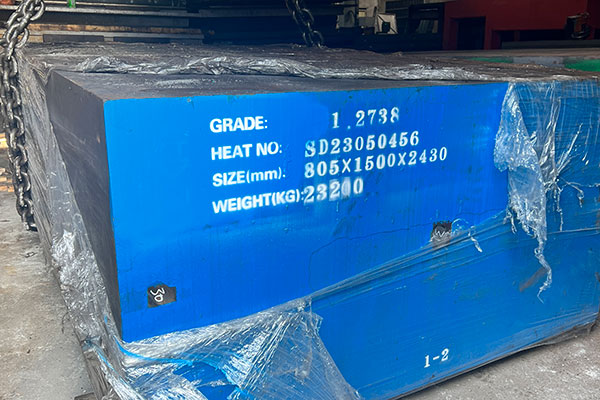
Both steels have excellent machinability and polishability, therefore , both  1.2311 and 1.2738 steel are all suitable for mould making.

The little difference is the hardness between them. 1.2311 and 1.2738 steel both are pre-harden steel , but 1.2311 hardness is 28-34HRC , 1.2738 is 30-36HRC.

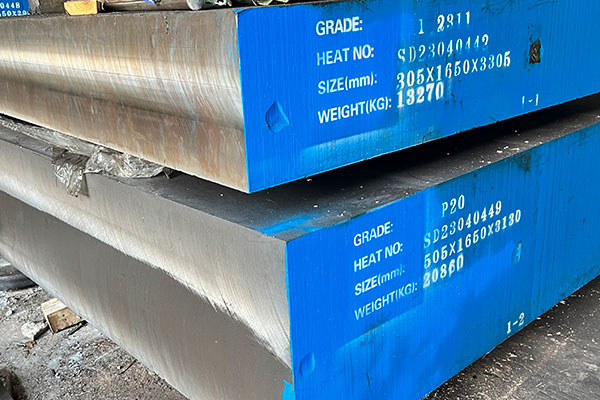
1.2311-plate-blockMechanical Properties 1.2311 VS 1.2738 steel :

1.2311:

  • Tensile Strength: 1050-1200 MPa.
  • Yield Strength: 950-1100 MPa.
  • Elongation: 15-20%.

1.2738:

  • Tensile Strength: 1000-1150 MPa.
  • Yield Strength: 900-1050 MPa.
  • Elongation: 15-20%.

In summary, both 1.2311 and 1.2738 steel grades have similar tensile and yield strength along with comparable elongation properties, the key difference is their hardness, toughness, and impact resistance. 1.2311 steel offers good wear resistance and dimensional stability with slightly lower hardness, while 1.2738 steel provides improved toughness and impact resistance due to the addition of nickel, making it suitable for applications requiring enhanced mechanical properties under high-stress conditions.

Price compare :

Considering  prices, 1.2311 steel is generally more cost-effective than 1.2738 steel due to differences in their chemical compositions . However, the overall cost may vary depending on factors such as market demand and supplier pricing.

Applications :

1.2311 Steel:

  • Widely used for low to medium-volume production of plastic molds, particularly for injection molding applications.
  • Suitable for making prototypes and master models due to its good machinability and polishability.
  • Often employed in industries such as automotive, consumer goods, and electronics for producing various plastic components and parts.
  • Ideal for applications where moderate mechanical strength and wear resistance are required, making it a cost-effective choice for molding applications with lower stress and impact requirements.

1.2738-STEEL-BLOCK1.2738 Steel:

  • Preferred for applications requiring higher toughness and impact resistance, especially in large-sized injection molds and tooling for automotive components.
  • Well-suited for molds subjected to high-stress conditions and impact loads, such as those encountered in automotive and aerospace industries.
  • Due to its enhanced toughness and resistance to deformation under high-stress conditions, 1.2738 steel is commonly used in applications where reliability and durability are paramount.
  • Offers superior performance in applications where the mold is subjected to frequent loading and unloading, as well as in situations where molds need to withstand abrasive wear and prolonged use.

In summary, both 1.2311 and 1.2738 steel grades have their respective applications in mold making, the key difference lies in the specific requirements of the application. 1.2311 steel is suitable for low to medium-volume production with moderate mechanical strength requirements, whereas 1.2738 steel is preferred for applications demanding higher toughness and impact resistance, particularly in large-sized molds subjected to high-stress conditions.

Conclusion:

In summary, both 1.2311 and 1.2738 steels offer excellent properties for mould making applications, with slight differences in their chemical compositions, hardness levels, and prices. The choice between the two ultimately depends on specific project requirements, budget considerations, and desired performance characteristics.


Otai special steel stock compelete size of 1.2311, 1.2738 steel, if there is any interest ,please contact below information to get the stock list.

0 Continue Reading →

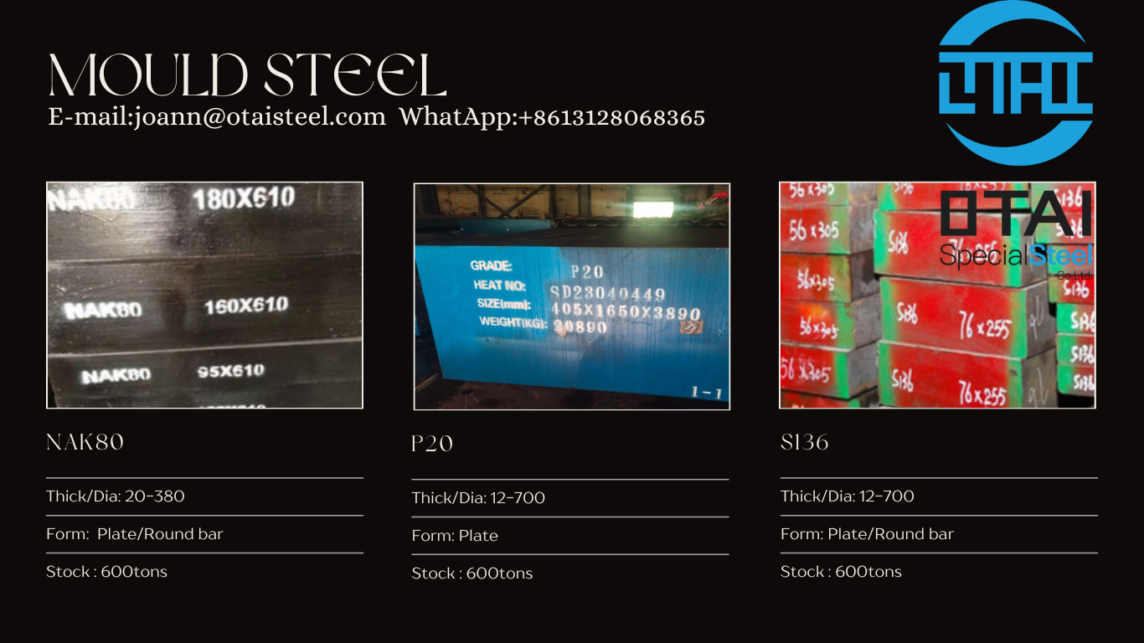
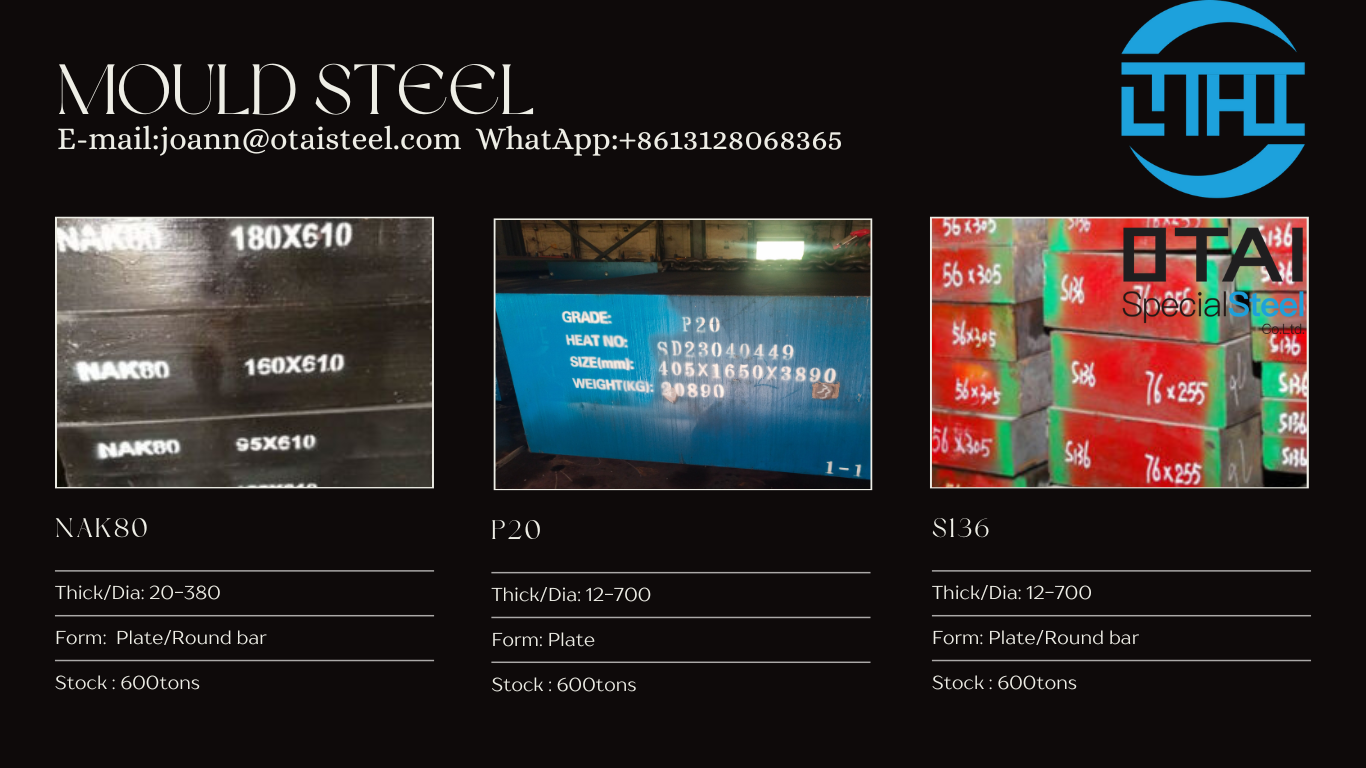
What mould steel is best for your mold? S136, NAK80 or P20?

This week, I had a customer inquire with us about several mould steel NAK80, S136 and P20. We knew that these steels would be used in plastic molds, and he wanted to compare the prices of these materials. This article analyzes the differences between the above materials and helps customers choose the most suitable material.

Description of mould steel S136,NAK80 and P20:

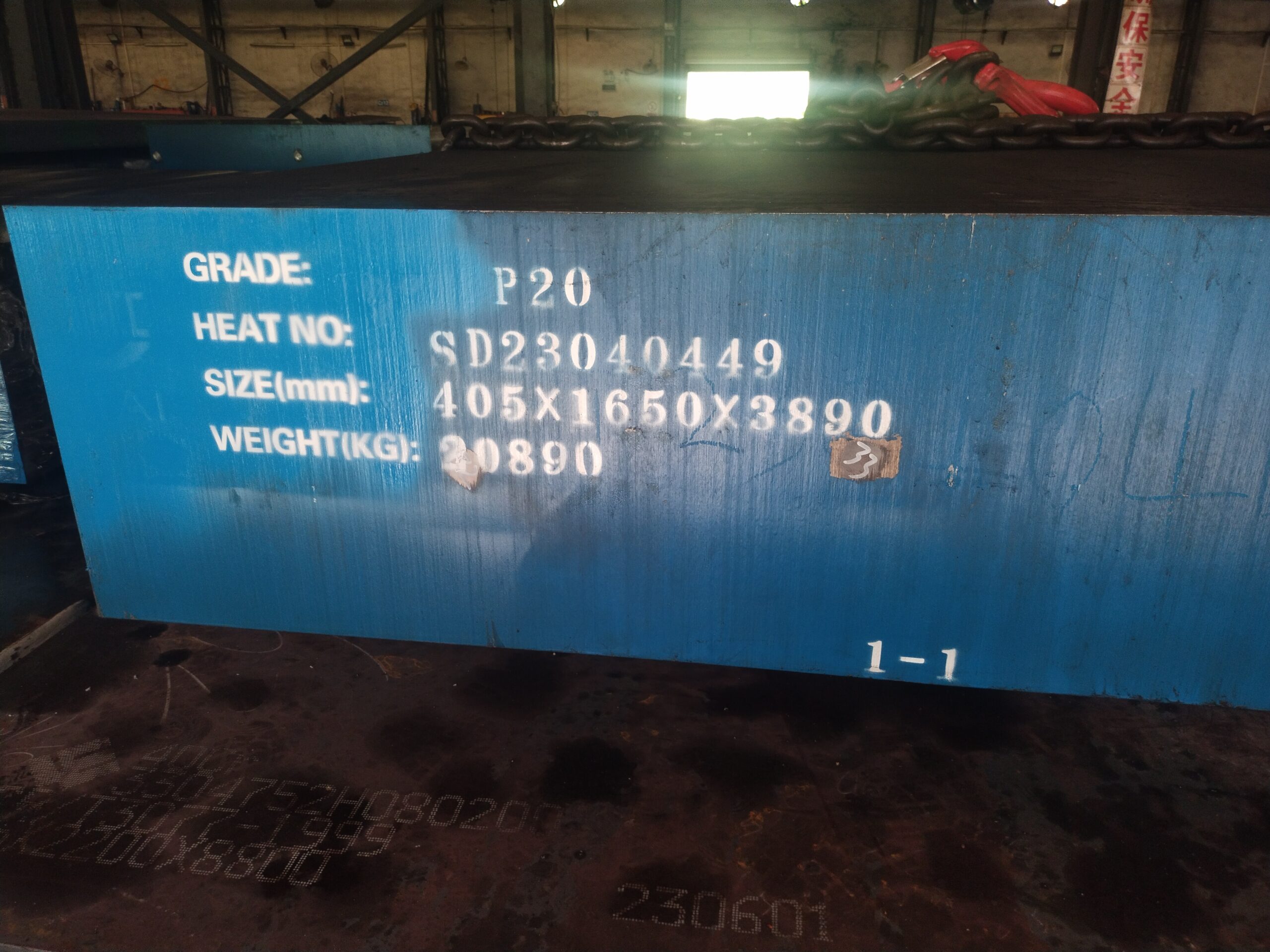
P20 steel plate S136 steel is chromium-nickel-molybdenum-vanadium alloy steel. As a high-quality plastic mold steel, S136 is widely used in injection molds, extrusion molds, blow molds and other fields. This mold steel has excellent corrosion resistance, polishability, wear resistance, and machinability, making it an ideal choice for manufacturing high-quality, high-precision plastic products.
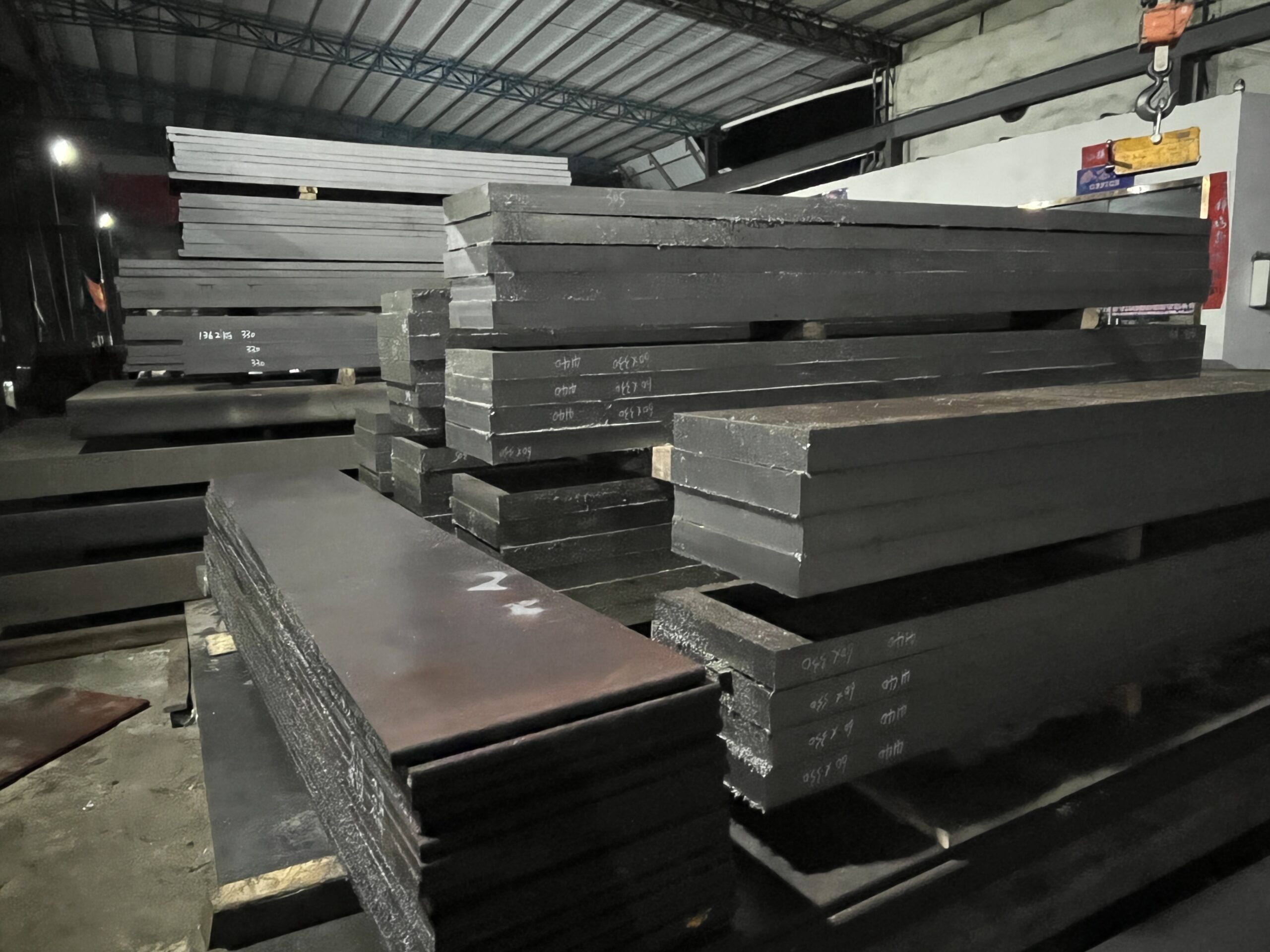
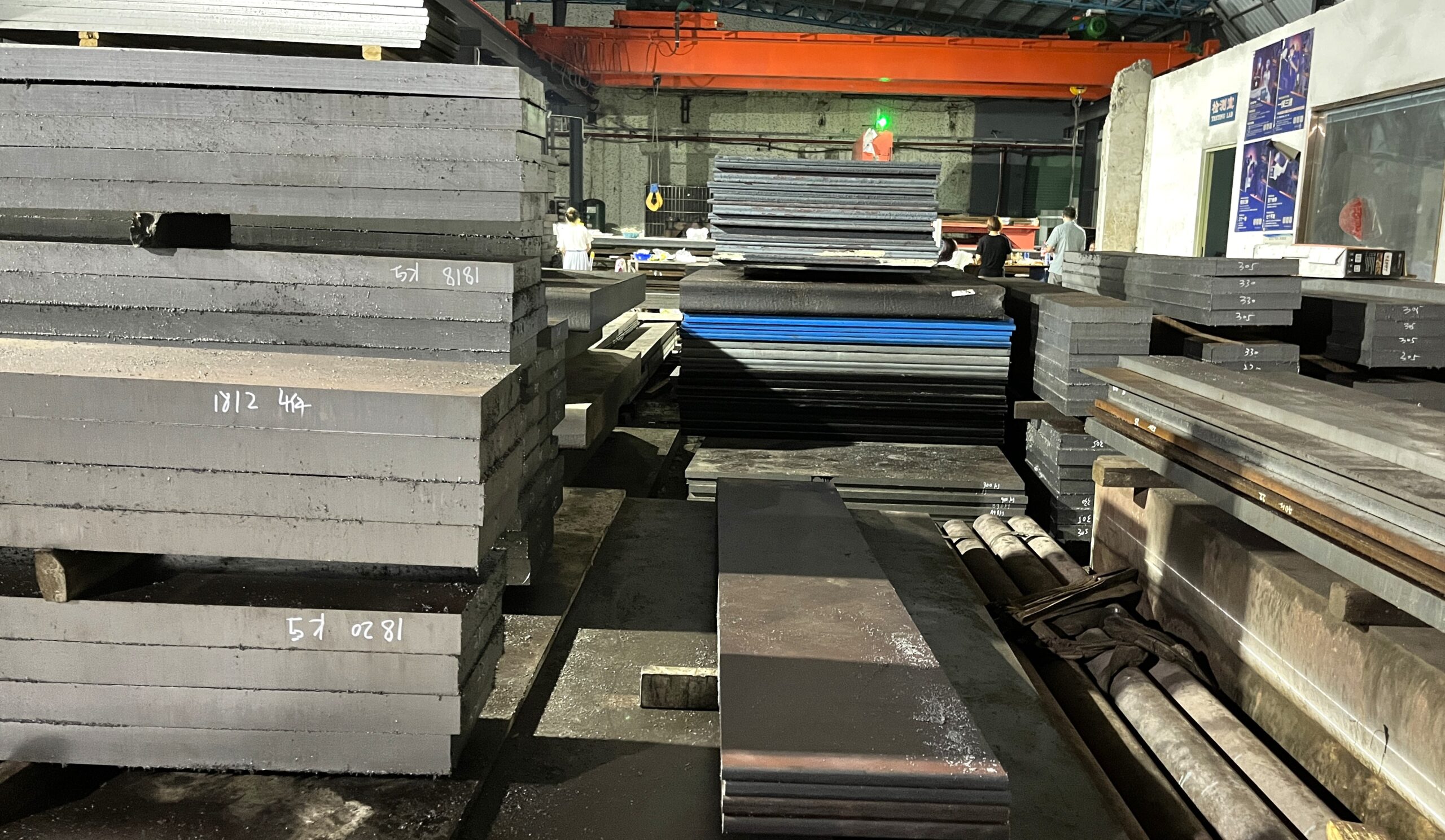
NAK80 steel  is a kind of pre-hardened plastic mold steel, it is from Japan ,Daido . NAK80 steel generally used for mirror polishing molds, dustproof, TV filter plates, cosmetic boxes, precision wrinkle treatment molds, office automation equipment, auto parts electrical discharge processing molds, etc.
P20 steel  is an American standard pre-harden plastic mold steel. Widely used in China, factory hardness HRC30~42, suitable for large and medium-sized precision molds, suitable for long-term production of high-quality plastic molds, and used for large mold bases. This steel has good machinability and can be generally polished.

Chemical composition difference

Grade C Si Mn S P  Cr
 ASSAB S136 Max0.38 Max0.80 Max0.50 MAX0.030 MAX0.030 Max13.6
Grade C Si Mn S P  Cr Mo
ASTM P20 0.28-0.40 0.20-0.80 0.60-1.00 ≤0.030 ≤0.030 1.40-2.00 0.30-0.55
Grade C Si Mn  Cr Mo  Ni Al Cu
 JIS NAK80 0.15 0.30 1.50 0.30 0.30 3.00 1.00 1.00

Characteristic between mould steel S136 , NAK80 and P20

S136 mold steel

  1. Corrosion resistance: It has excellent corrosion resistance and apply  in humid environments for a long time without rusting.
  2. High hardness: It has high hardness and can maintain good hardness and wear resistance at high temperatures.
  3. Excellent cutting performance: It has good cutting performance and is easy to process and manufacture.
  4. Good heat treatment performance: It has good heat treatment performance and can obtain the required hardness and strength through heat treatment.
  5.  Excellent wear resistance: It has excellent wear resistance and can maintain good surface finish and dimensional accuracy during long-term use.

NAK80 steel

  1.  High hardness: NAK80 mold steel is pre-hardened steel, and its hardness can reach 37-43HRC before leaving the factory.NAK80 STEEL
  2.  Excellent polishing performance: very suitable for molds with high surface requirements, such as optical devices or injection molded parts
  3. Ease of processing: NAK80 has very good processing performance, is easy to cut, mill and drill, and can meet the requirements of mold processing.
  4. Good thermal stability: NAK80 can still maintain stable performance in high-temperature working environments. It has a low thermal expansion coefficient and excellent thermal conductivity, and can effectively resist plastic mold deformation and thermal stress caused by high temperatures.

P20 steel

  1. Hardness: Factory pre-hardened, hardness 29-33HRC. Uniform hardness, good polishing performance and photo-etching performance, and good processing performance
  2. It has excellent cutting performance and wear resistance, and can withstand high pressure and impact. Suitable for long term mold use.
  3. P20 mold steel also has high strength and toughness and can withstand long-term mold work.
  4. It has good heat resistance and corrosion resistance, making it the first choice material for plastic injection molds.

Application between mould steel S136 , NAK80 and P20

NAK80  Steel application :

Mould steel NAK80 widely used in plastic injection molds, die-casting molds and precision molds also in industries such as auto parts, home appliances, electronic products, and medical devices.

It is suitable for flat panel displays, cameras, audio equipment, transparent covers, films and other shell molds with mirror polishing requirements.

S136 steel application

S 136 is suitable for plastic molds with high corrosion resistance and mirror polish requirements.

Therefore  the highly smooth surfaces of S136 steel for the production of optical products, such as cameras, sunglasses, chemical instruments and plastic products;

mould steelP20 Steel application

  • P20 is suitable for plastic molds and mold bases such as TV front casings, telephones, water dispensers, vacuum cleaners, etc.
  • Thermoplastic plastic injection molds, extrusion molds.
  • Thermoplastic blow molds. Heavy duty mold main components.
  • Cold structural parts.
  • Commonly used in manufacturing TV casings, washing machines, refrigerator inner casings, buckets, etc.

The difference of price between mould steel S136 , NAK80 and P20

P20 < S136 < NAK80

In conclusion

S136 , NAK80  and P20 are all good material widely used for steel mould.

But there are some application  differences.

  • If you need a mold with good polishability and relatively high requirements, you can choose NAK80 steel.
  • If you want to produce injection molds or extrusion molds with certain corrosion resistance but also have certain surface requirements, you can choose S136 steel.
  • If you have a budget Limited, if the surface requirements are not high, you can choose the more cost-effective P20 steel.

Otai special steel stock more than 1500tons for S136 , NAK80  and P20 steel. If you want to get the stock list and the price details , please contact below information:


Joann -Otai specai steelName: Joann

E-mail:joann@otaisteel.com

WhatsApp:+8613128068365

0 Continue Reading →

DIN 1.2083 Steel: Properties, Standards, and Applications

DIN 1.2083 steel, a martensitic stainless steel with a proven track record, is a front-runner in meeting the demanding requirements of hot pressing applications. Let’s delve deeper into the multifaceted aspects of this exceptional material, exploring its standards, dimensions, pricing, and more.

Stainless steel 1.2083 Standard

In the case of DIN 1.2083 steel, it is in compliance with the DIN EN ISO 4957 standard. This standard ensures that the steel meets stringent criteria, assuring users of its reliability and consistency.

1.2083 Steel Equivalents:

ISO EN 4957 ASTM A681
1.2083 / X40Cr14 420

Steel  1.2083 Chemical Composition:

C Si Mn S P  Cr
420 Min0.15 Max1.00 Max1.00 MAX0.030 MAX0.040 12.00-14.00
1.2083 0.36-0.42 Max1.00 Max1.00 MAX0.030 MAX0.030 12.50-14.50
Delving into the molecular makeup of DIN1.2083 unveils a precision-engineered alloy. Composed primarily of chromium, carbon, manganese, and molybdenum, this steel exhibits a well-balanced composition. The exact proportions contribute to its exceptional hardness, corrosion resistance, and machinability.

1.2083 Technical Information:

Density in kg/dm3 7,80
Young’s modulus (103 MPa) 200
Thermal conductivity at 20°C in W/(m K) 17,0
Specific heat capacity at 20°C in J/(kg K) 460

1.2083-round-barDIN1.2083 Heat Treatment:

  • Annealed:
    Under protective conditions, heat to 780°C and then cool to 650°C in the furnace at a rate of 10°C per hour, and then cool in the air.
  • Stress relief:
    After rough machining, it must be heated to 650°C, soaked for 2 hours, slowly cooled to 500°C, and then cooled in the air.
  • Hardening:
    Preheating temperature: 600-850℃
    Quenching temperature: 980-1050℃

1.2083 mold steel delivery status:

  • Soft annealing hardness: 210-241HB;
  • Quenching and Tempring (QT) hardness: 30-35HRC;
  • Quenching hardness: 48-55HRC.

Material Properties:

  1. Mechanical Strength and Toughness:
The stainless steel 1.2083  variant boasts robust mechanical strength and toughness, ensuring optimal performance under high-pressure hot pressing conditions.
  1. Corrosion Resistance:
With its martensitic structure, this steel exhibits excellent resistance to corrosion, making it an ideal choice for components exposed to corrosive plastics and abrasive elements.
  1. Machinability:
The inclusion of sulfur enhances machinability, facilitating the precise manufacturing of intricate components crucial in molding applications.
  1. Humid Atmosphere Compatibility:
Designed to withstand humid atmospheres and condensate, 1.2083 steel guarantees stability and longevity in challenging environmental conditions.
  1. Wear and Corrosion Resistance:
Tailored for high wear resistance, this steel excels in prolonged use within aggressive molding environments, ensuring longevity and reliability.
  1. Dimensional Stability:
Throughout the heat treatment process, 1.2083 maintains dimensional stability, a critical factor in achieving consistency in the final product’s size and shape.

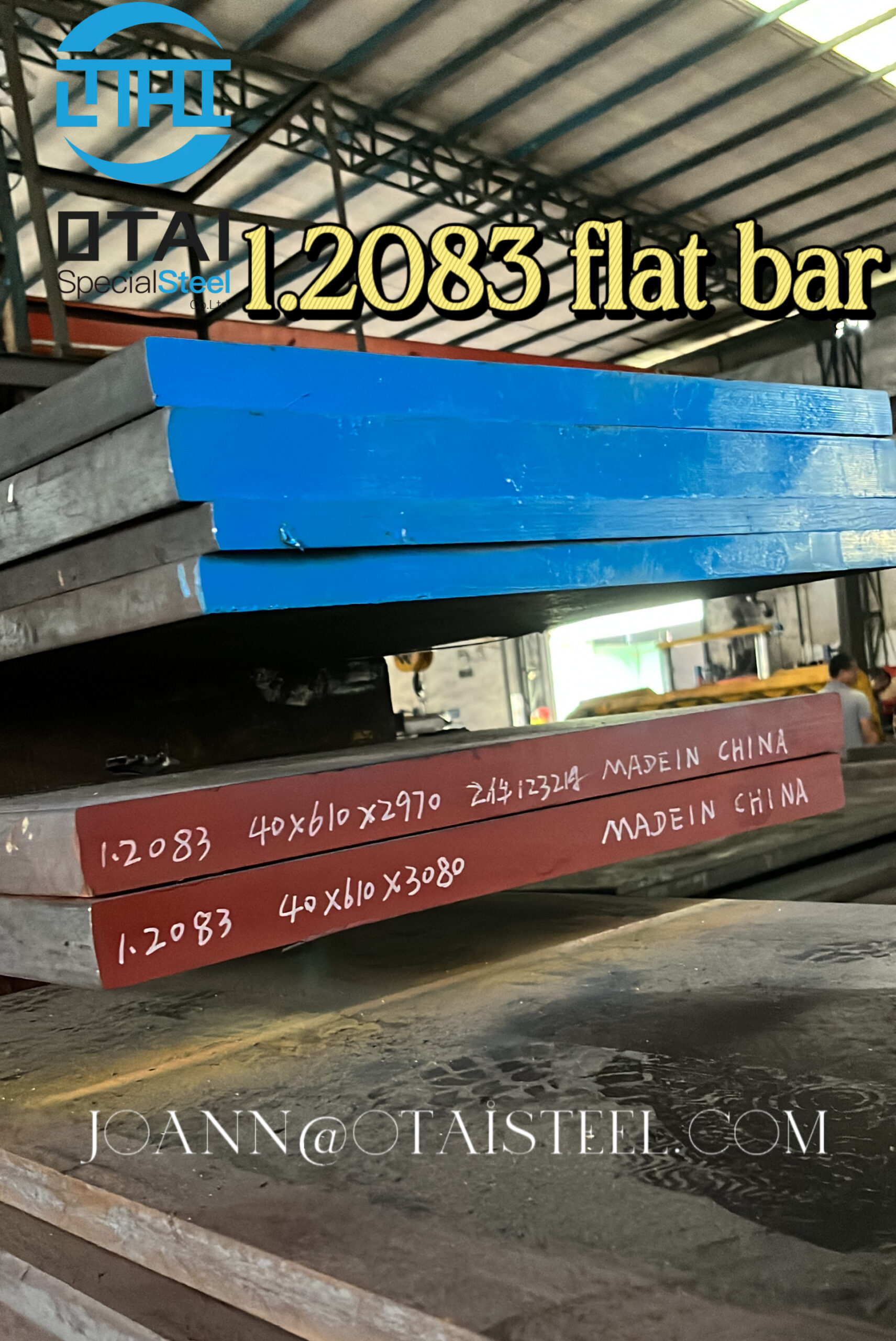
1.2083  Steel Applications:1.2083 steel flat bar

1.2083 steel finds its niche in molding applications, particularly in the manufacturing of molds and mold-holders for the plastics industry. Its unique combination of corrosion resistance, wear resistance, and machinability positions it as a top choice for professionals seeking superior performance in molding components, especially for materials like PVC.

1.2083 Steel Size and Customization:

1.2083 steel is available in diverse sizes, accommodating thicknesses up to 500 mm. This versatility allows for customization, meeting specific dimensional requirements for a wide range of molding applications.
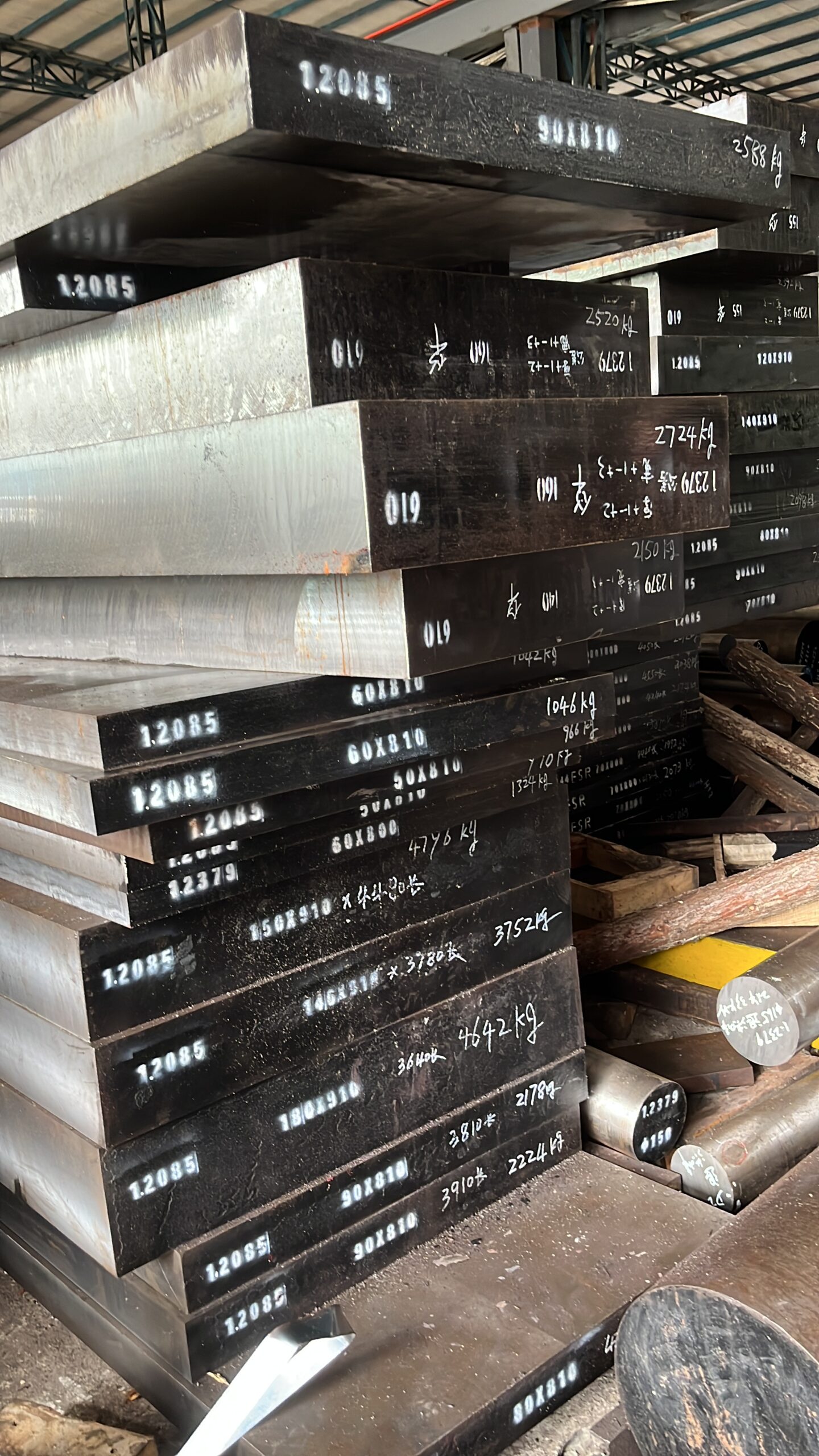
Otai special steel supply DIN 1.2083 steel round bar  diameter from 8mm to 500mm ,1.2083 steel flat bar thickness from 6mm to 500mm .And specific size can be customrized according customer’s request.

1.2083  Steel Price and Cost-effectiveness:

While pricing may vary based on factors such as size, quantity, and supplier, 1.2083 steel is renowned for its cost-effectiveness, offering a favorable balance between performance and affordability in the competitive molding industry.

Conclusion:

In the intricate world of plastics molding, steel 1.2083  emerges as a reliable cornerstone, embodying a blend of mechanical prowess, corrosion resistance, and machinability. As an industry-standard choice, its adherence to global standards, availability in various sizes, and cost-effectiveness position it as a go-to material for molding professionals seeking excellence in their craft. Whether you are molding intricate PVC components or tackling other challenging applications, 1.2083 steel stands as a testament to mastering molding excellence.

1.2083 flat bar Frequently Asked Questions (FAQs)

  • Is 1.2083 material suitable for high-precision molds?

Absolutely, 1.2083 material’s exceptional hardness and dimensional stability make it an excellent choice for crafting high-precision molds.

    •  How does 1.2083 steel compare to other stainless steel alloys? 

      While it shares similarities with AISI 420 stainless steel, 1.2083 boasts its own unique combination of properties, making it well-suited for specific applications.

  • Can 1.2083 material be used for medical instruments?

Certainly, the corrosion resistance and dimensional stability of 1.2083 steel make it an excellent choice for crafting high-quality medical instruments.

  • Where can I find reliable suppliers of 1.2083 material?

Reputable suppliers in the metallurgical industry can provide accurate quotes and ensure the quality and authenticity of 1.2083 steel. Otai special stel supply 1.2083 steel more than 10 years,and stock 1.2083 steel round bar more than 1000tons.

Want to know  more about the 1.2083 steel details and 1.2083 steel stock list ?

Pls contact : Joann

E-mail:joann@otaisteel.com

WhatsApp:+8613128068365

0 Continue Reading →

The Performance and Application of 1.2085 steel

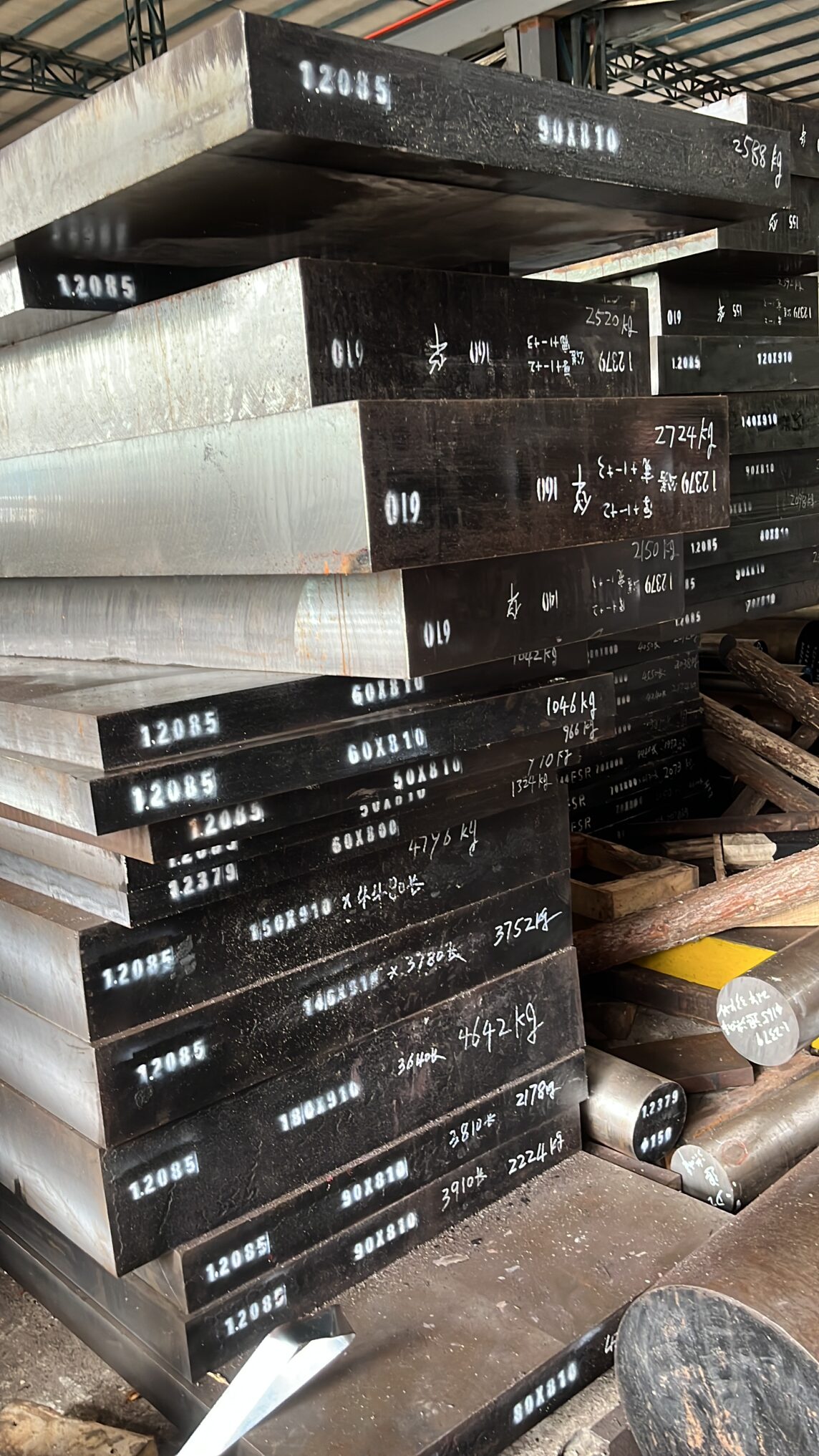
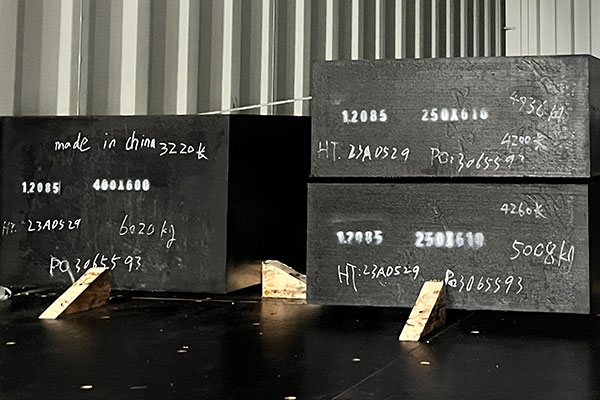
1.2085 steel, also known as 420FM stainless steel, is a high-carbon stainless steel.It offers a good hardness, corrosion resistance, and affordability. In this artical, we will explore the performance and applications of 1.2085 .

Chemical Composition

C Si Mn S P  Cr Mo Ni
1.2085 0.28-0.38 Max1.00 Max1.40 0.050-0.100 MAX0.030 15.00-17.00 / Max1.00

Performance of 1.2085 steel

Hardness and Wear Resistance

One of the key characteristics of 1.2085 is its excellent hardness. It harden through heat treatment processes, making it suitable for applications that require a sharp cutting edge or resistance to wear. This property makes 1.2085 steel a popular choice for knife blades and cutting tools.

1.2085-steel-blockCorrosion Resistance

While not as corrosion-resistant as some other stainless steels like 304 or 316, 1.2085 still offers good resistance to corrosion, especially in environments with low to moderate levels of moisture and exposure to corrosive elements. Proper maintenance and care can help enhance its longevity in corrosive conditions.

Toughness

1.2085  exhibits good toughness, which is important for applications where the material may be subjected to impact or sudden loads. This quality ensures that the steel can withstand moderate levels of stress without fracturing or chipping.

Long-lasting cutting edge performance

Due to its higher carbon content, its hardness properties are better. In this way , when 1.2085 use in cutting steel, the sharpness of the cutting edge can be maintained for a long time, which makes it less frequent and more environmentally friendly.

Applications of 1.2085 Steel

Knife making

1.2085  is most commonly used in tool production. Its higher hardness, better corrosion resistance and edge retention ability make it outstanding in tool production. Particularly used as kitchen knives and outdoor tools, 1.2085  provides reliable performance.

Cutting tools

1.2085  can also used to make cutting tools such as blades, scissors, and saws. Its hardness and wear resistance make it ideal for tools that are subject to constant wear and tear

Surgical Instruments

In the medical field, 1.2085  utilize for surgical instruments. Its ability to  sterilize, along with its hardness and corrosion resistance, make it an appropriate material for tools used in surgical procedures.

Industrial Applications

Beyond the mentioned applications, 1.2085 finds use in various industrial settings where a combination of hardness and corrosion resistance is required. This can include components for machinery, valves, and other mechanical parts.

Conclusion

1.2085 steel, the combination of its properties of hardness, corrosion resistance, and affordability, finds wide-ranging applications in industries such as cutlery, toolmaking, and medical instruments. Its performance characteristics make it a good choice for various applications.

FAQs

1. Is 1.2085  suitable for outdoor knives?

Yes, 1.2085  is a popular choice for outdoor knives due to its hardness, corrosion resistance, and edge retention.

2. How should I maintain 1.2085 steel tools to ensure longevity?

Regular cleaning and proper storage in a dry environment can help prolong the life of 1.2085 steel tools.

3. Can 1.2085  be heat treated at home?

While it is possible to heat treat 1.2085  at home, it recommend to consult a professional for best results.

4. What industries commonly use 1.2085 steel in their applications?

1.2085  commonly use in industries such as cutlery manufacturing, toolmaking, and medical instrument production.

5. Is 1.2085 steel magnetic?

Yes, 1.2085  is magnetic, as it belongs to the martensitic stainless steel family which is generally magnetic in nature.

Want to know more about the details ?

Pls contact : Joann

E-mail:joann@otaisteel.com

WhatsApp:+8613128068365

0 Continue Reading →