Skip to Content

About: Joann

Recent Posts by Joann

4140 vs 4130 Steel : Which one suitable for you?

If you’re comparing 4140 and 4130 steel, you’re probably holding a drawing in one hand and a calculator in the other. You need the right material—not just the one that looks good on paper.

So, what’s the real difference? In short: carbon content. 4130 contains 0.28–0.33% carbon, while 4140 contains 0.38–0.43%. That small gap—roughly 0.10%—creates a completely different personality for each steel.

Think of them as two tools from the same workshop. 4130 is the flexible wrench that bends without breaking. 4140 is the hardened hammer that delivers maximum force but doesn’t like being twisted.

 Standards and Equivalent Grades

Both grades belong to the AISI/SAE 41xx series, meaning they share chromium and molybdenum as key alloying elements. Here are their global equivalents:
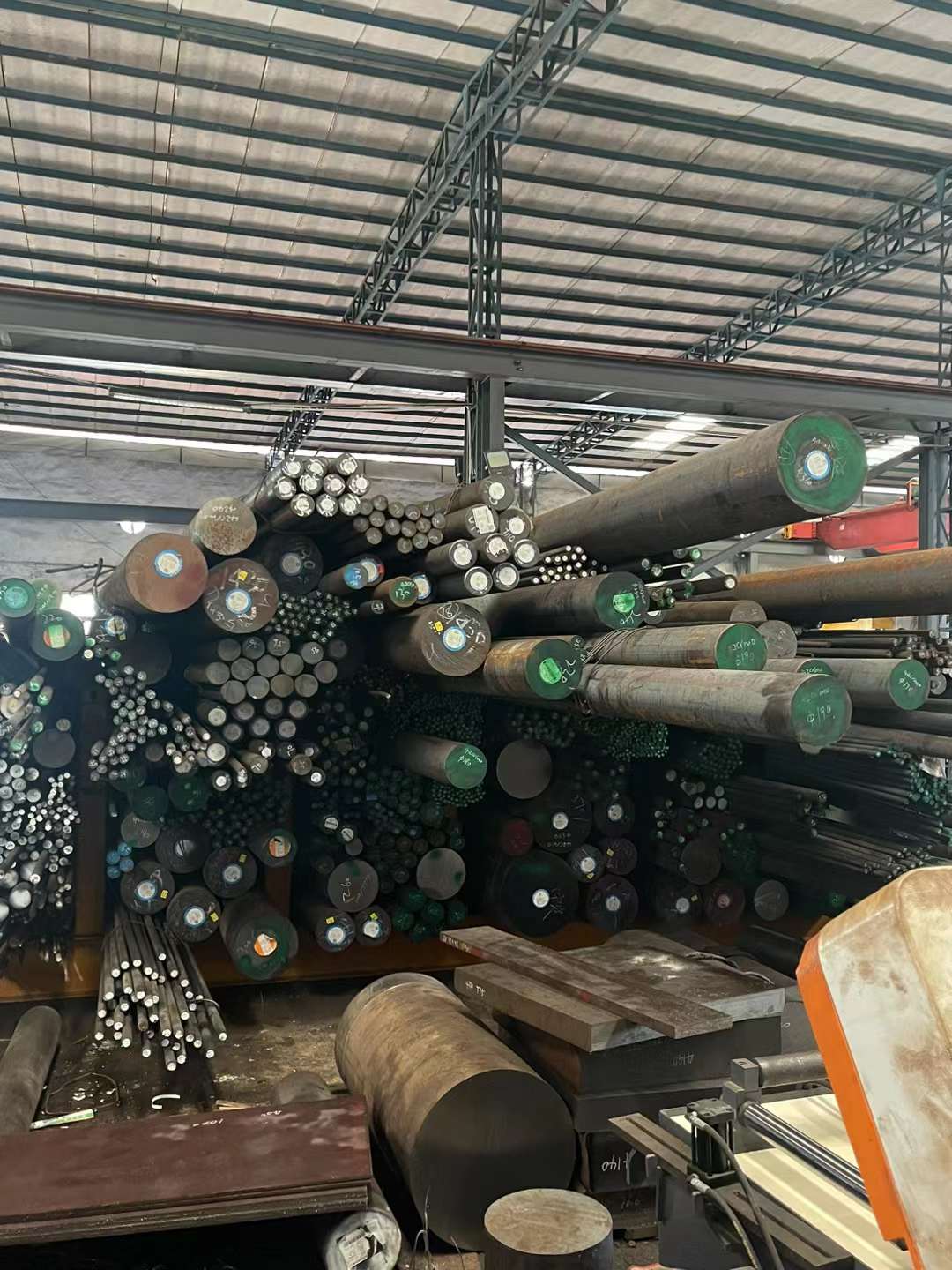
 

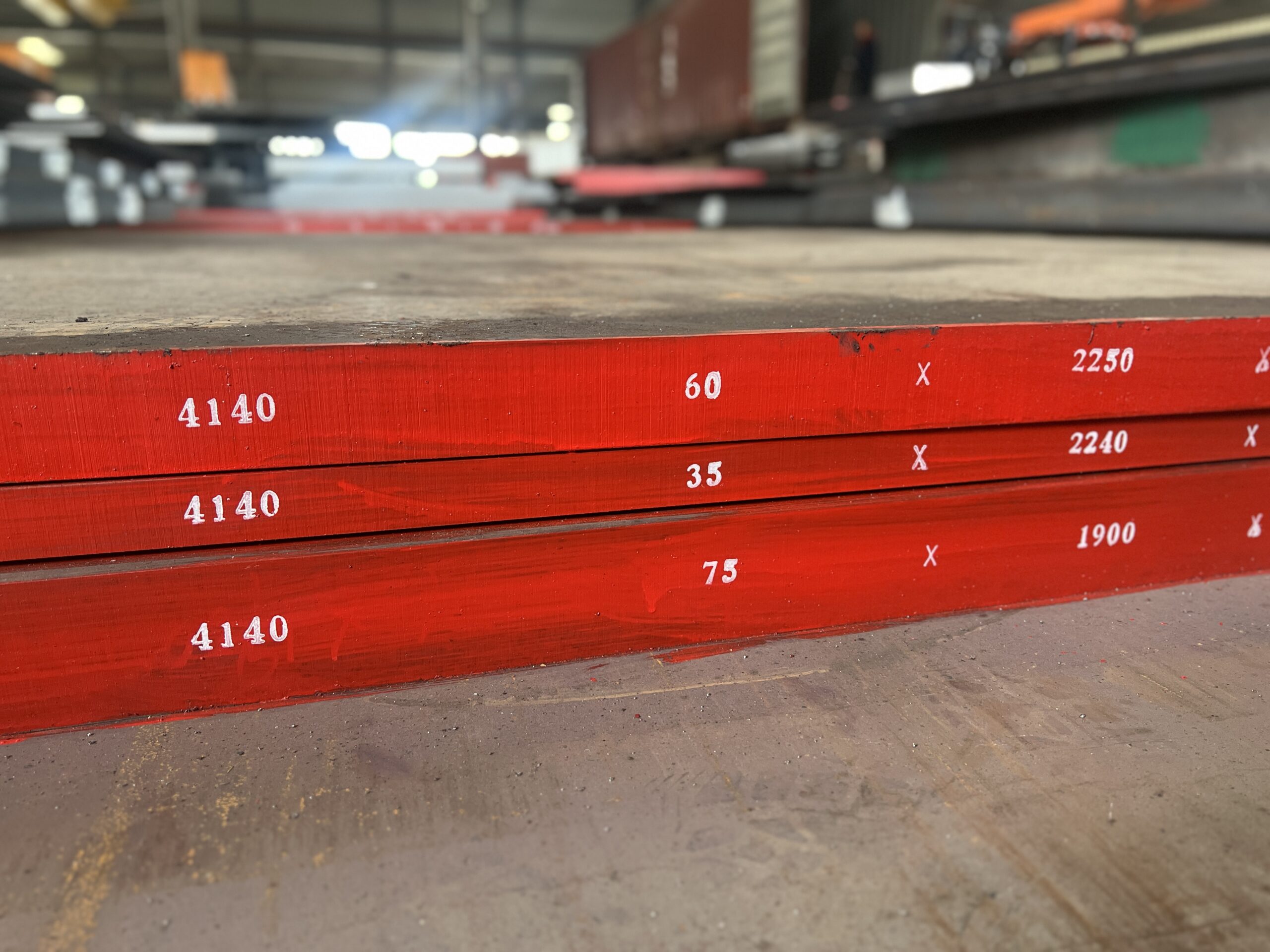
4140 vs 4130 stelel round bar

Standard 4130 4140
AISI/SAE 4130 4140
JIS SCM430 SCM440
DIN 1.7218 (25CrMo4) 1.7225 (42CrMo4)
GB (China) 30CrMo 40CrMo
UNS G41300 G41400

If your customer specifies 42CrMo4, you need 4140. If they ask for 25CrMo4, that’s 4130. Simple.

Chemical Composition 4140 vs 4130 Steel

Let’s put the numbers side by side. Pay attention to carbon and manganese.

Element (%) 4130 4140
Carbon (C) 0.28 – 0.33 0.38 – 0.43
Manganese (Mn) 0.40 – 0.60 0.75 – 1.00
Chromium (Cr) 0.80 – 1.10 0.80 – 1.10
Molybdenum (Mo) 0.15 – 0.25 0.15 – 0.25
Phosphorus (P) ≤ 0.035 ≤ 0.035
Sulfur (S) ≤ 0.040 ≤ 0.040

Why does this matter? Higher carbon directly increases strength and hardness but reduces ductility and weldability. The extra manganese in 4140 improves hardenability—meaning it responds more deeply to heat treatment.

Peformance Properties 4140 vs 4130 Steel

Mechanical Properties 4140 vs 4130 Steel

Here is where the two grades truly separate. Assume both are heat treated to 28–32 HRC.

Property 4130 4140
Tensile Strength (MPa) ~850 – 950 ~1000 – 1200
Yield Strength (MPa) ~650 – 750 ~850 – 1000
Elongation (%) 12 – 18% 10 – 14%
Reduction of Area (%) 45 – 55% 35 – 45%
Impact Toughness (Charpy) Excellent Good to Moderate

4140 steel

In plain English:4140 is stronger. 4130 is tougher. If your part experiences sudden impact or vibration, 4130 absorbs the energy better. If your part needs to resist deformation under high static load, choose 4140.

Technical Properties: Hardenability, Weldability, and Machinability

This section often determines the final decision.

Hardenability (Jominy Test)

– 4130: Shallow hardenability. Sections thicker than 50mm may retain a soft core after quenching in oil.
– 4140: Deep hardenability. You can harden sections up to 100mm or more in oil. For larger diameters, water quenching is possible.

Weldability 4140 vs 4130 Steel

– 4130: Good. Pre-heat to 150–250°C. Post-weld stress relief is recommended but not always mandatory for thin sections.
– 4140: Fair to poor. Requires pre-heat at 300–400°C, strict interpass temperature control, and immediate post-weld heat treatment. Skip these steps, and you risk hydrogen cracking.

Machinability  4140 vs 4130 Steel

– 4130 (annealed):Gummy and tendency to form built-up edge. Use sharp tools and proper coolant.
– 4140 (pre-hardened 28–32 HRC): Excellent. Produces short, broken chips and good surface finish.

Rhetorical question for you: Do you really want to manage a complex welding procedure for 4140 if 4130 will do the job? Probably not.

Typical Applications 4140 vs 4130 Steel

Let’s match the steel to real-world use.

Industry 4130 Applications 4140 Applications
Aerospace Aircraft tubing, structural frames Landing gear components (heat treated)
Automotive Roll cages, chassis, suspension parts Axles, crankshafts, steering knuckles
Oil & Gas Downhole tools, drill collars (light duty) Heavy-duty drill collars, tool joints
General Engineering Welded structures, hydraulic tubing Gears, spindles, bolts, die holders
Tooling Not common Sockets, wrenches, hammer heads, mold bases

Analogy time: 4130 is your reliable pickup truck—does the job every day without drama. 4140 is the semi-truck—massive capacity, but you wouldn’t use it to pick up groceries.

 Available Sizes (From Otai Special Steel)

We stock both grades in a wide range of dimensions. Here’s what you can expect:

Form 4130 4140
Round Bar 6mm – 200mm dia. 6mm – 800mm dia.
Flat Bar 10mm – 150mm thickness 10mm – 300mm thickness
Seamless pipe 20mm – 200mm OD (seamless) 20mm – 300mm OD (seamless)
Plate 20-70mm thickness  stock 8mm – 200mm thickness

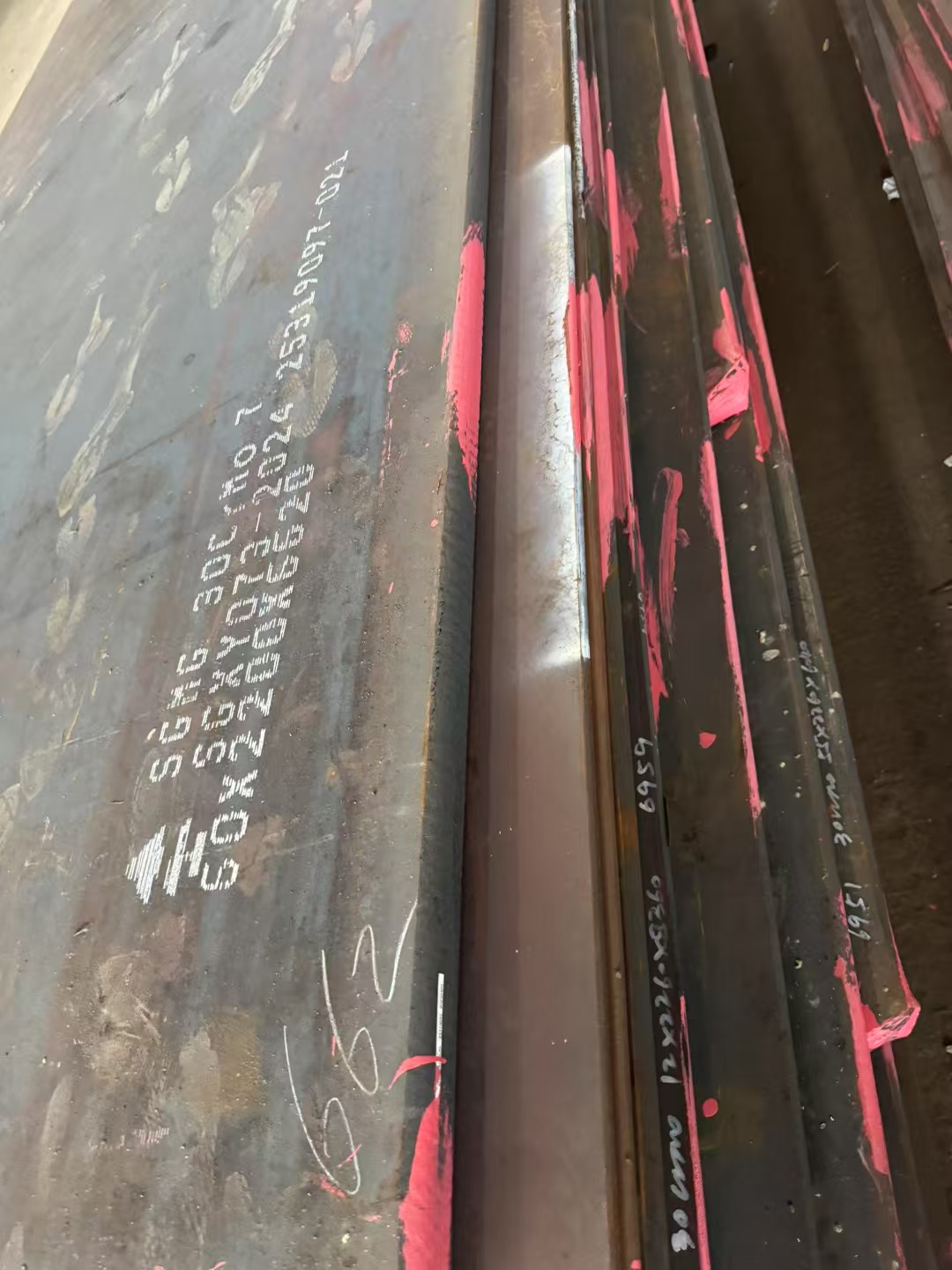
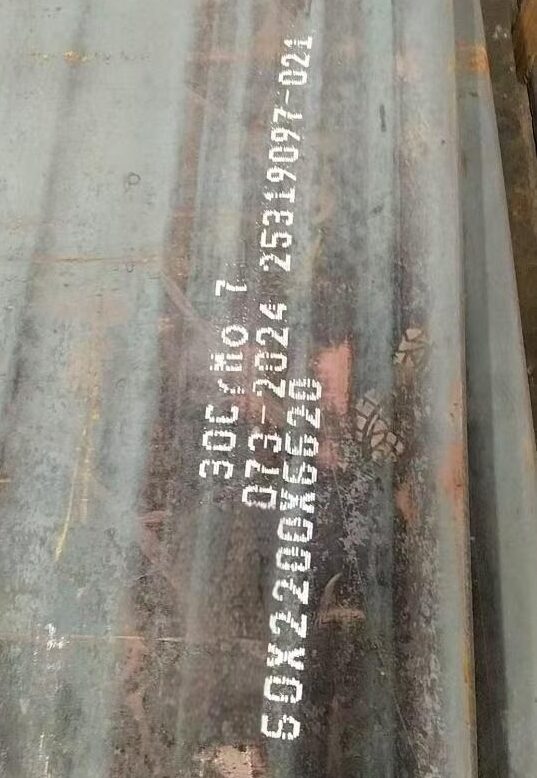
30CrMo steel-otai

Need a non-standard size? Contact us. We do custom cutting and turning.

 Price Comparison 4140 vs 4130 Steel

Let’s talk money openly. 4140 typically costs 10–20% more than 4130 for equivalent dimensions and quantities.

Why? Three reasons:

  1.  Higher alloy content (manganese and tighter carbon control)
  2.  More demanding heat treatment requirements
  3. Lower production volumes for certain shapes

But here’s my professional advice: Do not select based on price alone. I’ve seen buyers choose 4130 to save $200 per ton, only to experience premature wear. I’ve also seen engineers spec 4140 unnecessarily, paying extra for strength they never used.

Calculate the total lifecycle cost, not just the raw material price.

Additional Technical Considerations (Expert Ideas)

Here are four extra points that experienced engineers appreciate.

a. Surface Wear Resistance
4140 forms a harder, more durable surface under nitriding or induction hardening. For shafts running against seals or bushings, 4140 lasts significantly longer.

b. Stress Relieving
Both grades require stress relief after heavy machining. For 4130, use 600–650°C. For 4140, use 550–600°C. Do not skip this step—especially for precision components.

c. Cold Forming
4130 bends and forms more easily in the annealed condition. 4140 resists cold forming and may crack if you attempt tight radii.

d. Flame Hardening
4140 responds beautifully to flame or induction hardening (achieving 50–55 HRC at the surface). 4130 does not—you’ll struggle to exceed 45 HRC.

Final Recommendation (Stop Guessing)

If you need… Choose…
High weldability and good toughness 4130
Deep hardenability for thick sections 4140
Fatigue resistance under vibration 4130
High surface wear resistance 4140
Easy machining in pre-hardened condition 4140
Cost-effective solution for welded structures 4130

Still unsure? Send your application details to Dongguan Otai Special Steel. Tell me the part function, thickness, welding requirements, and expected loads. I’ll give you a clear, objective recommendation—no upselling, no vague answers.

Because at Otai, we don’t just sell steel. We sell the right steel for your job.

Contact us today for a quote or technical consultation.

Joann
Name: Joann


0 Continue Reading →

4130/30CrMo/25CrMo4/1.7218/SCM430 Steel

4130 steel is widely used in aerospace field , oilfield, and tooling shops.

Think of 4130  as the reliable pickup truck of the alloy steel world. It isn’t flashy. But when you need to get the job done—without excuses—this is what you reach for.


What Exactly Is 4130 Steel?

4130 is a low-alloy steel containing chromium and molybdenum as its primary strengthening elements. The “41” in the AISI designation tells you it contains approximately 1% chromium and 0.2% molybdenum. The “30” refers to a carbon content of around 0.30%.

Because of this specific chemistry, 4130 offers an excellent combination of strength, toughness, and fatigue resistance. It responds very well to heat treatment, yet remains weldable and machinable in the annealed condition.

In simple terms: you can harden it when you need strength, or leave it soft when you need to cut or bend it. That flexibility is rare.


4140 seel supplierGlobal Standards and Equivalent Grades

If you source steel internationally, you need to know how 4130 steel translates across different standards. Here is the direct comparison: 

Country USA BS BS Japan China
Standard ASTM A29 EN 10250/EN10083 BS 970 JIS G4105 GB/T-3077-2015
Grades 4130 25CrMo4/1.7218 708A25/708M25 SCM430 30CrMo

Chemical Composition of 4130 Steel and equivalent steel 

The performance of 4130 steel starts with its chemistry. Every element plays a specific role. Here is the typical composition range:

Standard Grade C Mn P S Si Cr Mo
ASTM A29 4130 0.28-0.33 0.40-0.60 Max 0.035 Max 0.040 0.15-0.35 0.80-1.10 0.15-0.25
EN10250
/EN10083
25CrMo4/
1.7218
0.22-0.29 0.60-0.90 Max 0.025 Max 0.035 Max 0.40 0.90-1.2 0.15-0.30
JIS G4105 SCM430/
SCM2
0.28-0.33 0.60-0.85 Max 0.030 Max 0.030 0.15-0.35 0.90-1.2 0.15-0.30
GB/T-3077-2015 30CrMo 0.26-0.33 0.40-070 Max 0.030 Max 0.030 0.17-0.37 0.80-1.20 0.15-0.25

Because of this precise blend, 4130  achieves a balance that plain carbon steels simply cannot match. It air-hardens to some degree, but more importantly, it responds predictably to quench-and-temper heat treatment.


Mechanical Properties of 4130 Steel

The numbers below represent typical values for 4130 in different conditions. Always refer to your specific mill test report for exact figures, but this gives you a reliable benchmark.

Condition Tensile Strength (MPa) Yield Strength (MPa) Elongation (%) Hardness (HRC)
Annealed 560 – 600 360 – 400 22 – 28 ~15 HRC
Normalized 650 – 700 430 – 480 20 – 25 ~18 HRC
Quenched & Tempered (Low) 850 – 950 700 – 800 15 – 20 25 – 30 HRC
Quenched & Tempered (High) 1000 – 1150 850 – 1000 10 – 15 32 – 38 HRC

What does this mean for you?

In the annealed condition, 4130  machines easily and bends without cracking. After heat treatment, it becomes significantly stronger than mild steel—yet it retains enough ductility to absorb shock loads.

That combination is precisely why 4130 dominates applications like roll cages, chassis components, and downhole tools. It doesn’t just resist yielding. It also resists sudden fracture.


Technical Properties: Welding, Machining, and Forming

Knowing the chemistry and strength numbers is one thing. But you probably want to know: How does 4130 steel behave under my tools?

Let me break it down.

Welding 

4130  is widely considered the most weldable low-alloy steel in its strength class.

  • No preheat required for wall thicknesses under 4mm (0.160″) when using low-hydrogen practices.

  • Recommended filler metals: ER80S-D2 for TIG/MIG, or E8018-B2 for stick welding.

  • Post-weld heat treatment is generally not required for thinner sections, but stress relieving at 600–650°C improves fatigue life for critical components.

Here is a practical tip: If you weld 4130 steel in the annealed condition, the heat-affected zone will harden slightly. That’s normal. Just keep your interpass temperature below 300°C.

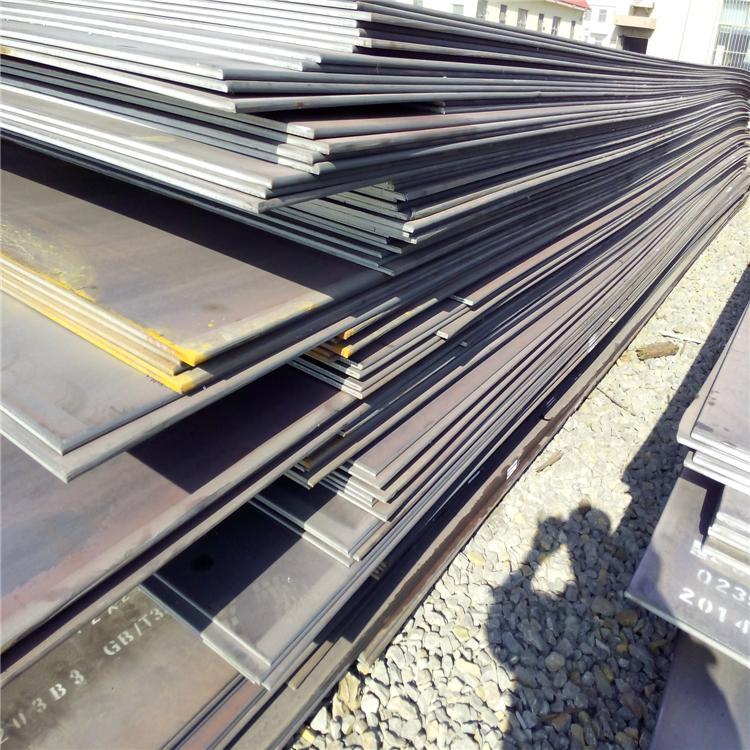
30CrMo steel plate -otai

Machining 

In the annealed state, 4130 machines about 10–15% harder than 1018 mild steel. But with carbide tooling and proper speeds, it cuts cleanly and produces a good surface finish.

  • Recommended speed for turning: 80–120 SFM with carbide.

  • Feed rates: Similar to medium-carbon steel.

  • Surface finish: Easily achieves 63 microinches or better.

If you need to machine 4130 steel after heat treatment (above 35 HRC), expect shorter tool life and consider CBN or ceramic inserts.

Forming and Bending

Because 4130 has good ductility in the annealed condition, it bends and forms readily. You can cold-bend tube and bar stock with standard equipment. Just avoid sharp radius bends without a mandrel.

For tight radii, warm forming at 400–500°C reduces springback and prevents cracking.


Applications: Where Is 4130 Steel Used?

4130 steel appears in industries where failure is not an option. Here are the most common applications we see at Otai:

Industry Typical Components
Motorsports Roll cages, chassis tubing, suspension arms, steering components
Aerospace Aircraft fuselage tubing, engine mounts, landing gear parts
Oil & Gas Downhole drilling tools, subs, crossovers, mandrels
Cycling High-end bicycle frames (Reynolds 525/725 series)
Tooling Punches, dies, tool holders, fixture components
Firearms Receivers, bolts, and barrel nuts
General Engineering Shafts, gears, hydraulic cylinder rods

If your product experiences vibration, impact, or cyclic loading, 4130 steel is often the most cost-effective solution.


Available Sizes and Forms at Dongguan Otai Special Steel

We maintain a large inventory of 4130 steel in multiple forms and dimensions. You don’t have to wait for mill production. We ship from stock.

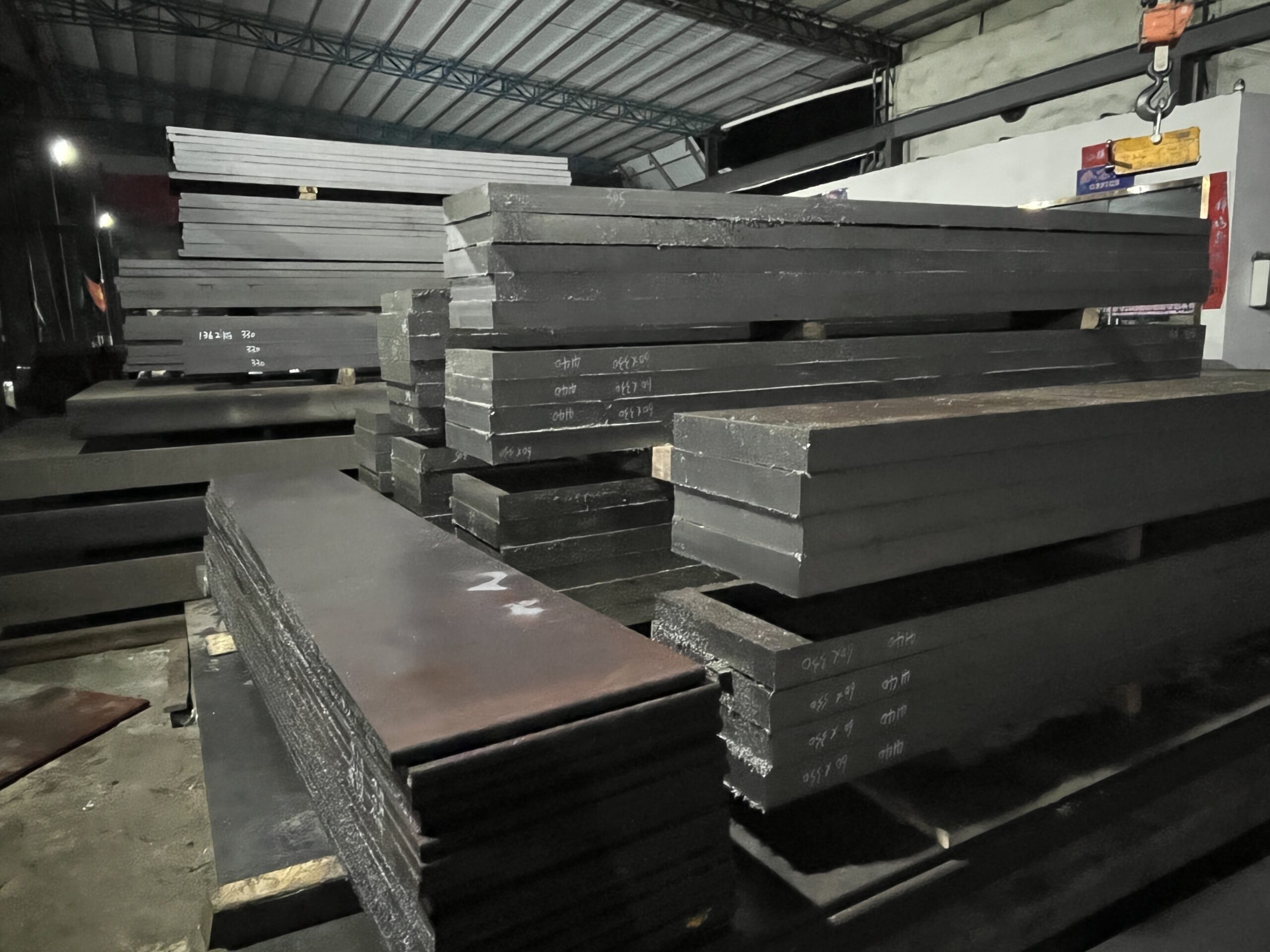
30CrMo steel plate stock -otai

Form Diameter / Thickness Surface Condition
Round Bar 6mm – 800mm Hot rolled/forged ,

black surface/turning surface;

Seamless Tube 12mm OD – 300mm OD Hot rolled, black surface
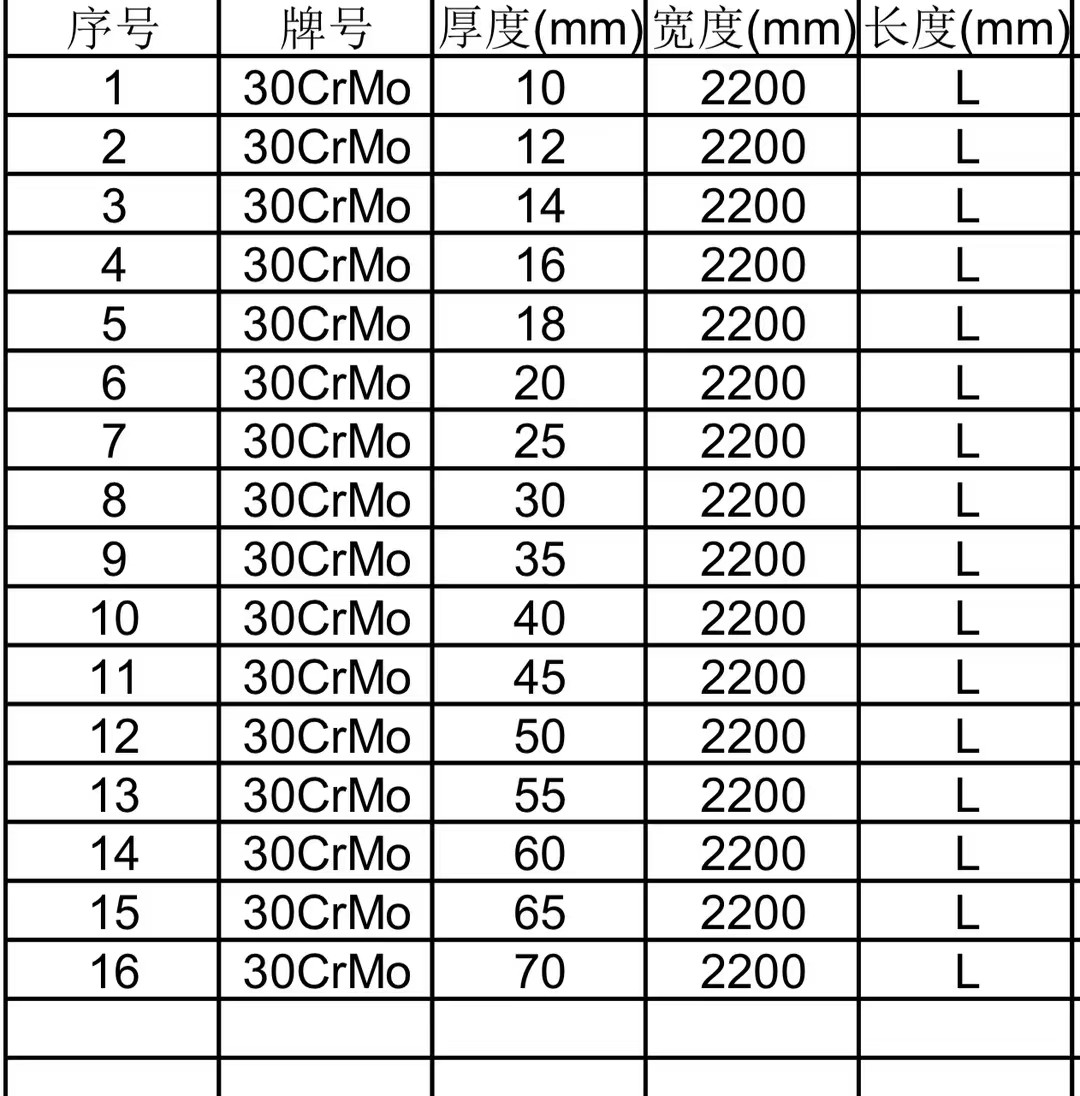
Flat Bar/Plate / Sheet 10mm – 70mm thick Hot rolled, black surface

Need a custom size? We offer precision cutting, centerless grinding, and turning to your exact specifications.


Price Considerations for 4130 Steel

Let’s address the question everyone asks: How much does 4130 steel cost?

Compared to standard mild steel (A36, Q235, or S235JR), 4130 steel carries a premium of approximately 20–40%. That premium buys you significantly higher strength, better fatigue resistance, and reliable heat treatment response.

Compared to stainless steel or high-alloy tool steels, 4130 steel is substantially more affordable—often half the price or less.

At Otai, our pricing remains competitive because:

  • We buy directly from mills in large volumes.

  • We are based in Dongguan, a global manufacturing hub with lower operating costs.

  • We ship efficiently to ports worldwide.

For an exact price, contact us with your size, quantity, and destination. We respond within 24 hours.


30CrMo steel plate -OtaiWhy Buy 4130 Steel from Dongguan Otai Special Steel?
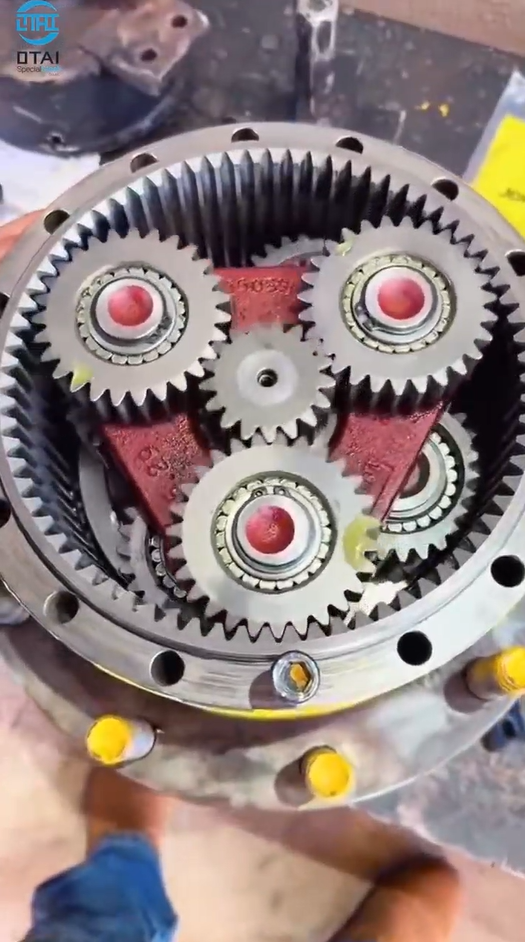
You have choices when sourcing 4130 steel. Here is why our customers stay with us:

  1. Certified material – Every shipment includes mill test reports.

  2. Large stock range – We carry sizes from 6mm round bar up to 800mm.

  3. Cut-to-length service – No minimum order quantity for cutting.

  4. Technical support – Our engineers answer welding, heat treating, and machining questions.

  5. Fast shipping – Export packing and documentation included.

We don’t just sell 4130 steel. We help you use it successfully.


Final Thoughts: Is 4130 Steel Right for Your Project?

Let me leave you with this.

If you need a steel that offers high strength without sacrificing weldability, 4130 steel is difficult to beat. It handles heat treatment well. It machines cleanly in the soft state. And it performs reliably under fatigue and impact.

Is it the cheapest material on the market? No. But if your application involves safety, durability, or cyclic loading, the small upfront premium pays for itself many times over.

Ready to order 4130 steel? Send an inquiry to Dongguan Otai Special Steel. Tell us your dimensions, quantities, and delivery requirements. We’ll send you a quote and a certificate of analysis.

Name: Joann
0 Continue Reading →

16MnCr5 Steel: The Gearbox Hero You’ve Been Looking For

16MnCr5 steel is an alloy steel which has good hardenability and machinability. For larger cross-section parts, it can achieve high surface hardness and wear resistance after heat treatment, and also has high low-temperature impact toughness. 16MnCr5 gear steel, after carburizing and quenching, is mainly used to manufacture gears, worm gears, and sealing bushings.

What Exactly Is 16MnCr5 steel?

Think of 16MnCr5 like a peanut M&M.

The inside is soft, tough, and chewy – that’s your core toughness. The outside is hard, crunchy, and takes all the abuse – that’s your wear-resistant surface.

That’s exactly what case-hardening does. You get a component that’s hard on the outside (to resist friction and wear) but still tough on the inside (to absorb shocks and impacts without snapping).

16MnCr5 is a low-alloy case-hardening steel that follows the DIN EN 10084 standard. It’s used everywhere – automotive, heavy machinery, precision engineering, you name it.

 16MnCr5 steel Chemical Composition


Element Content (%) What It Does
Carbon (C) 0.14 – 0.19 Low enough for tough core
Manganese (Mn) 1.00 – 1.30 Boosts strength and hardenability
Chromium (Cr) 0.80 – 1.10 Creates the hard surface after carburizing
Silicon (Si) ≤ 0.40 Deoxidizer, keeps it clean
Phosphorus (P) ≤ 0.025 Kept low for toughness
Sulfur (S) ≤ 0.035 Kept low for machinability

16MnCr5 for gear

See that manganese and chromium together? That’s the magic combo. Manganese gives you a strong, ductile core. Chromium gives you that beautiful hard shell

after heat treatment.

Where Does 16MnCr5 Come From? (Standards & Equivalents)

Nobody likes hunting down equivalent grades. So here’s your cheat sheet:

Standard Country Equivalent Grade
DIN/EN (Germany) Europe 16MnCr5/1.7131
AISI/SAE (USA) United States 5115
JIS (Japan) Japan SMnC420
BS (UK) United Kingdom 655M13
GB (China) China 20CrMn
UNI (Italy) Italy 16MnCr5

A quick warning: AISI 5115 is close but not chemically identical. Always double-check your specs before swapping.

How Does 16MnCr5 steel Perform?

Let me give you the headline numbers. These are for soft-annealed condition (as you’d receive it from us) and after quenching + tempering.

Property Soft Annealed Quenched + Tempered
Tensile Strength 500 – 700 MPa 800 – 1,100 MPa
Yield Strength 300 – 450 MPa 550 – 850 MPa
Elongation (how much it bends before breaking) 18 – 22% 10 – 14%
Surface hardness (after carburizing) N/A 58 – 62 HRC
Core hardness (after carburizing) N/A 30 – 45 HRC

Here’s what those numbers mean in real life. The core stays tough and ductile – so your gear tooth won’t snap off under shock loading. The surface gets incredibly hard – so it won’t wear out after a million cycles.

Fatigue strength for 16MnCr steel? About 450 – 550 MPa in rotating bending. That’s roughly 30-40% better than plain carbon steel like 1045. That’s the difference between a gearbox that lasts 500 hours and one that lasts 5,000 hours.

Application for 16MnCr5 steel

Honestly? Anything that needs to survive friction without snapping in half.gear 2

– Gears (especially transmission gears – this is the classic application)
– Camshafts and cam followers
– Piston pins
– Bushings and sleeves
– Spindles and shafts
– Hydraulic components
– Chain pinions
– Worm gears

Ever wonder why some machine parts last 10 years and others last 10 months? Often, it’s the steel choice. **16MnCr5 is the “10-year” option.**

Heat Treatment – The Secret Sauce

Raw steel is only half the story. Heat treatment is where 16MnCr5 comes alive.

Here’s the typical process:

  1. Carburizing– Add carbon to the surface at high temperature (around 880-980°C)
  2.  Hardening – Quench in oil to lock in that hard surface
  3.  Tempering – Relieve internal stress at 150-200°C

After this process, you get:

– Surface hardness: 58 – 62 HRC
– Case depth: 0.5 – 1.8 mm (adjustable by time and temperature)
– Core hardness: 30 – 45 HRC (still tough and ductile)

Think of it like a lollipop. Hard candy shell. Soft chewy center. The surface takes the scratches. The core takes the load. Beautiful partnership.

How Does 16MnCr5 steel Compare to Other Grades?

You’re probably wondering – why not just use 8620? Or 20MnCr5? Or plain 1045?

Grade Toughness Wear Resistance Best For
16MnCr5 Very Good Good Balanced performance
20MnCr5 Good Better Heavier gears, higher loads
8620 Excellent Fair Maximum core toughness
1045 Fair Poor Low-cost, non-critical parts


My honest take: If you need maximum core toughness, buy 8620 – but you’ll pay more. If you need maximum surface hardness, buy 20MnCr5 – again, more expensive. But if you want the sweet spot – good wear resistance, good toughness, and a reasonable price – 16MnCr5 is your answer.

Sizes We Stock

Nobody wants to hear “we can get it in six months.” At Otai Special Steel, we keep real inventory on the floor.

Form Size Range
Round Bar 6mm – 800mm diameter
Flat Bar 10mm – 200mm thickness
Plate / Sheet 8mm – 150mm thickness
Block Custom cut to order


And yes – we cut to your exact lengths. You don’t have to buy a six-meter bar when you only need 400mm. That’s just common sense.

What About Price of 16MnCr5 Steel?

Everyone wants to know, but nobody wants to ask. So I’ll tell you straight.

16MnCr5 steel sits in the mid-range price bracket. It’s more expensive than plain carbon steel (like 1045 or 1020), but significantly cheaper than high-alloy tool steels (like H13, D2, or 8620).

Why? Because it’s a balanced alloy. Not too much chromium. No expensive nickel or molybdenum. You get 80% of the performance of fancier grades at maybe half the cost.

That’s not marketing – that’s just smart engineering.

Want a specific price per kilogram or per ton for your size and quantity? Just email us. We reply fast – usually within a few hours.

Why Buy From Dongguan Otai Special Steel?Wear-resistant steel plate

I could give you a long, polished marketing speech. But here’s the short, honest version:

– We’re specialists – steel is all we do. Not bearings. Not fasteners. Just high-quality special steel.
– Real inventory – not just a “supplier network” that dropships from someone else.
– Cut-to-size service – fast lead times, no minimum order headaches.
-We speak engineering – not just sales. Ask us a technical question. You’ll get a real answer.
– Full traceability– mill certificates included with every order.

We’re based in Dongguan, but we ship worldwide. Europe, North America, Southeast Asia, the Middle East – we’ve done it all.

One Last Thought Before You Go

If you’re designing a gear, a shaft, a pin, or any component that needs a hard surface and a tough core – don’t overcomplicate it.

You don’t always need special, expensive alloys. Sometimes, the smartest choice is a classic. And 16MnCr5 steel is about as classic as it gets.

So here’s my question to you: What are you building next?

And if 16MnCr5 steel sounds like the right fit – or even if you’re not sure – just reach out. I’d rather help you choose the right steel than sell you the wrong one. That’s not just good business. That’s just being honest.

Dongguan Otai Special Steel
Your steel partner, not just a supplier


Joann
Name: Joann


0 Continue Reading →

S1 Steel: A Good Choice in Punching and Shearing Operations

Ever feel like your tools are just one impact away from a catastrophic crack? You are not alone.

In the world of stamping and shearing, brittle tools are a nightmare. They shatter, ruin your production schedule, and frankly, they cost you a fortune in downtime. That is where  S1 Steel  steps into the ring.

Think of S1 as the “Bodyguard” of the tool steel world. It doesn’t just sit there looking hard; its job is to take the punch—literally—and ask for more. At Dongguan Otai Special Steel, we see this material save our clients’ operations every day. Let me break down why this specific grade might just be the hero your workshop needs.

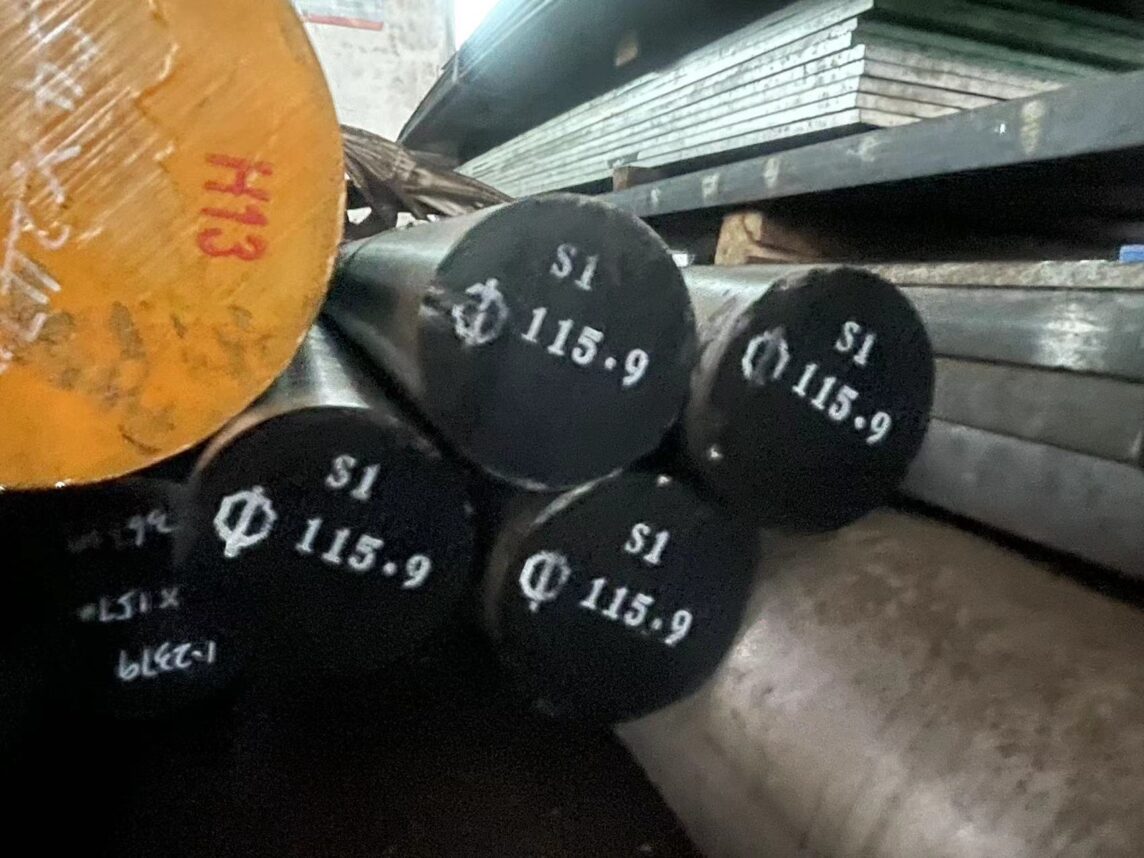
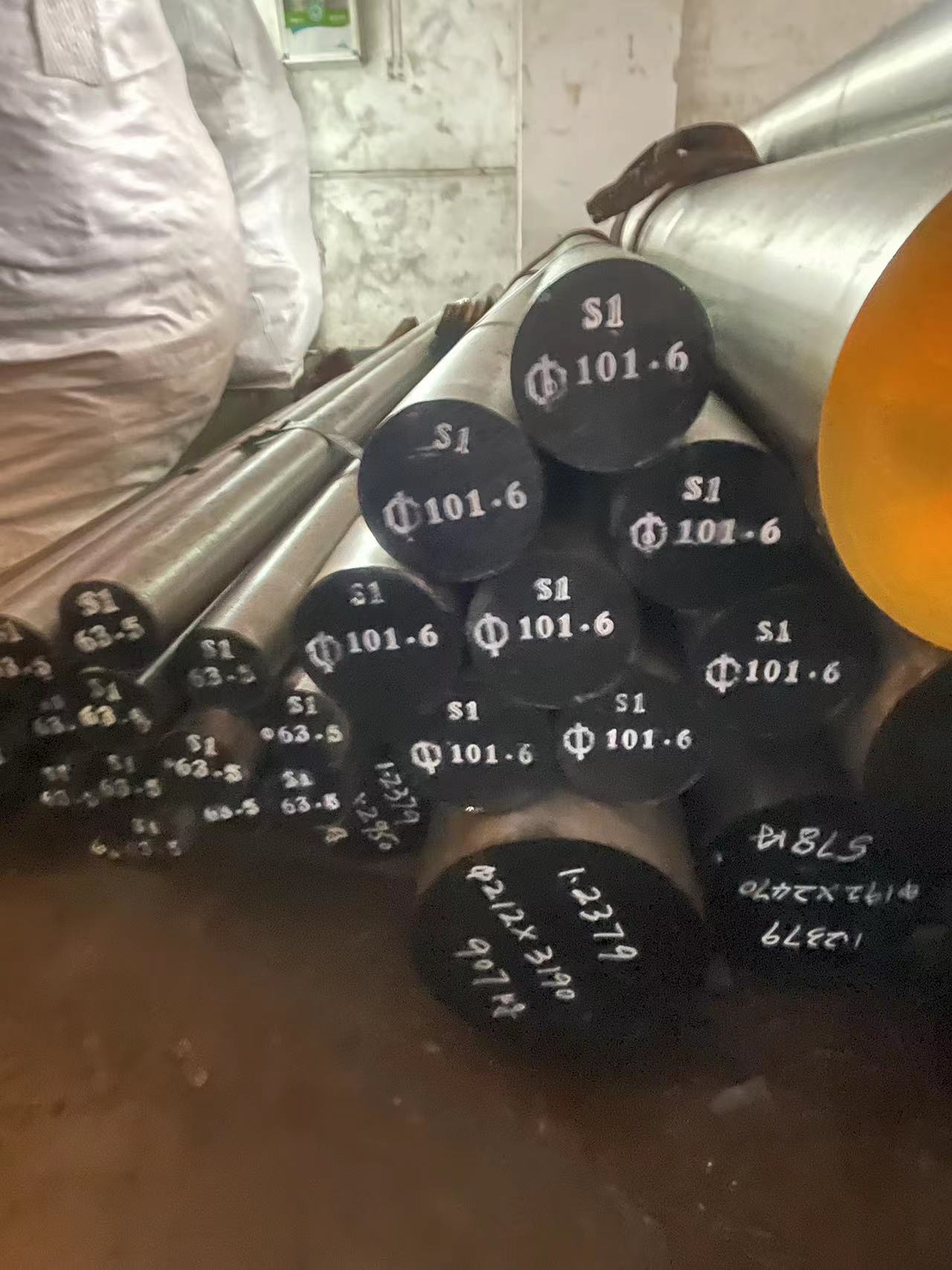
S1 STEEL ROUND BAR-OTAI

What Exactly is S1 Steel?

In technical terms, S1 is a Shock-Resisting Tool Steel. But let’s ditch the jargon for a second.

While other steels focus on being hard as glass (and sadly, just as breakable), S1 focuses on Toughness. It has a specific recipe of alloys designed to absorb vibration, heavy impact, and sudden loading without falling apart.

Under the hood (or the microscope), this is what the chemistry looks like according to ASTM A681 standards :

Element Percentage (%) What it does for you
Carbon (C) 0.40 – 0.55 The backbone – gives it the hardness needed to cut.
Silicon (Si) 0.15 – 1.20 The shock absorber – boosts strength and fatigue resistance.
Chromium (Cr) 1.00 – 1.80 The endurance coach – adds hardenability and wear resistance.
Tungsten (W) 1.50 – 3.00 The secret weapon – prevents softening from heat and friction.
Vanadium (V) 0.15 – 0.30 The grain refiner – keeps the microstructure tight and tough.

Equivalent steel grade for S1 steel

USA Germany China Japan France England Italy Russia Czechia Austria Sweden Spain
DIN,WNr GB JIS AFNOR BS UNI GOST CSN ONORM SS UNE
S1 45WCrV7 | 1.2542 5CrW2Si‑V L2 45WCrV8 2542
BS1
45WCRB8KU 5ХВ2СФ 19732 2710 45WCRSI8


The “Aha!” Moment: Where S1 Steel Beats the Others

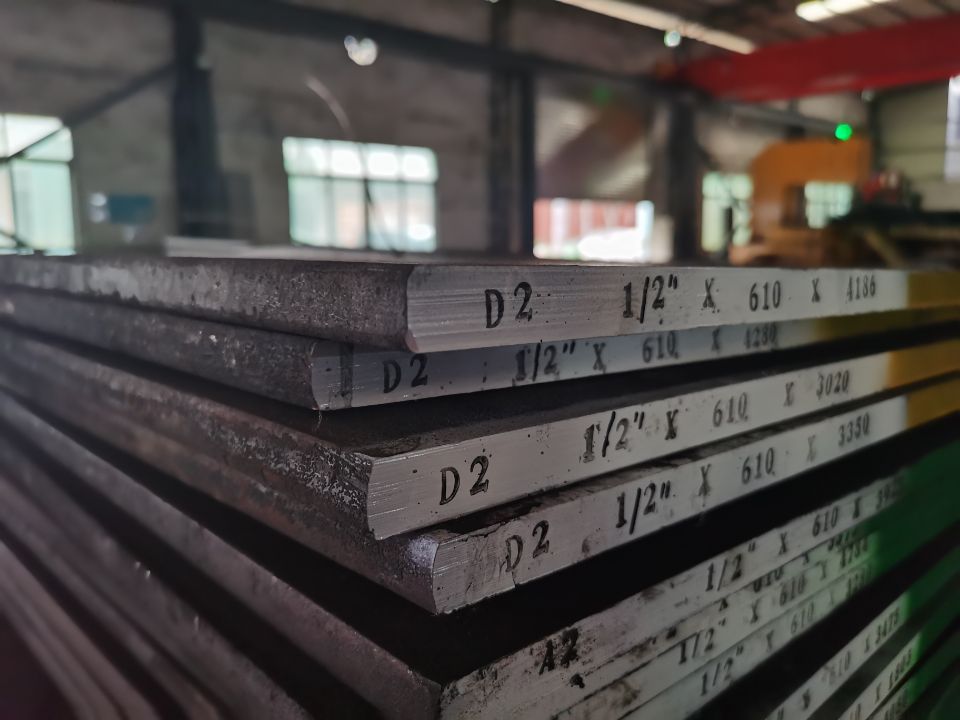
D2 plateSo, why choose S1 over something like D2 or O1? Simple.
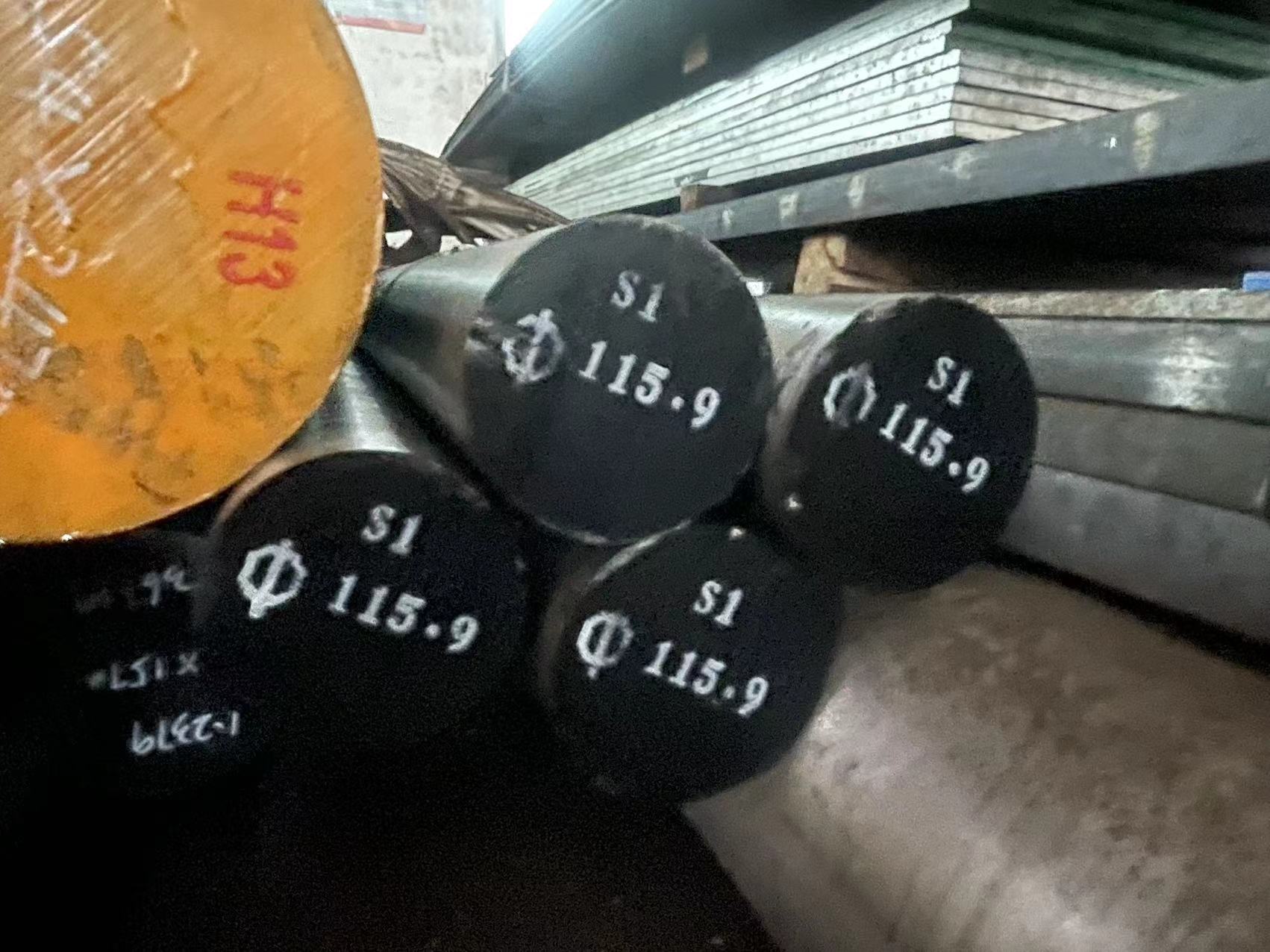
D2 steel  is like a ceramic plate—super hard, great for wear, but drop it and it’s in a million pieces.
S1 steel is like a rubber tire**—tough, resilient, and able to take a beating. It resists deformation and chipping at a level that high-carbon steels just can’t touch.

You get a working hardness of 56-60 HRC. That is plenty hard enough to cut metal sheeting or shape wood, but with a ductility that makes machining and heat treatment a breeze.

 Where Does S1 Steel Actually Work?

Because of this “take-a-hit” attitude, S1 is the gold standard for tools that experience sudden impact. You will find S1 steel excelling in roles where other steels fear to tread .

– Pneumatic Tools: Think chisels, rivet snaps, and breaker tool bits. These live a life of constant vibration.
– Shear Blades: For cutting scrap metal or cropping bars. The blades take a massive shock with every cut.
– Cold Forming Dies: Punches and dies that slam into metal hundreds of times a minute.
– Woodworking: Shock-resistant knives for planing hardwood knots.

 The Practical Stuff: Sizes, Prices, and Availability

At Otai, we don’t just sell certificates; we sell steel you can use. We keep a massive inventory of S1 steel (also known internationally as DIN 1.2554 or 45WCrV7) ready to ship.

Available Forms & Dimensions:

– Round Bar: Usually in the range of 16mm to 800mm diameter. Perfect for punches and rods.
– Flat Bar / Plate: Thickness from 10mm to 600mm, width up to 910mm. Ideal for shear blades and dies .

A Note on Price:

Because S1 contains Tungsten (which is a dense, high-cost alloy), it sits at a moderate price point. It is certainly more expensive than plain carbon steel, but here is the kicker: it is significantly cheaper than high-speed steels (like M2) in the long run. Why? Because the reduced risk of catastrophic failure means you save money on emergency repairs and lost production time.

S1 STEEL ROUND BAR-OTAI

 Heat Treatment Made Simple

One of the best parts about S1? It is very forgiving.

– Annealing: Heat to 750°C – 800°C (1382°F – 1472°F), cool slowly in the furnace.
– Hardening: Pre-heat to 650°C – 700°C, then raise to 900°C – 950°C (1652°F – 1742°F).
– Quenching: Oil quench is standard (or air for thinner sections).
– Tempering:Temper immediately. For that sweet spot of 56-58 HRC, hit a double temper at 400°F – 600°F .

The Bottom Line (And a Quick Ask)

Look, if you are shearing soft materials or punching delicate holes, maybe you don’t need S1. But if you are tired of hearing that “CRACK” sound when your punch hits a hard spot in the material—you need S1 steel.

At Dongguan Otai Special Steel, we specialize in providing steel that solves problems, not creates them. We can cut S1 to your exact length, grind it to your tolerance, and get it to your door before you run out of patience.

Are you currently fighting with chipping or breaking tools? Shoot us a message with your application. Let’s see if S1 is the right bodyguard for your machine.

Contact Otai Special Steel today. Let’s get your tools working harder and smarter.


Joann
Name: Joann


0 Continue Reading →

A8 Modified/1.2360 vs. D2 Steel – Which One Saves Your Tooling?

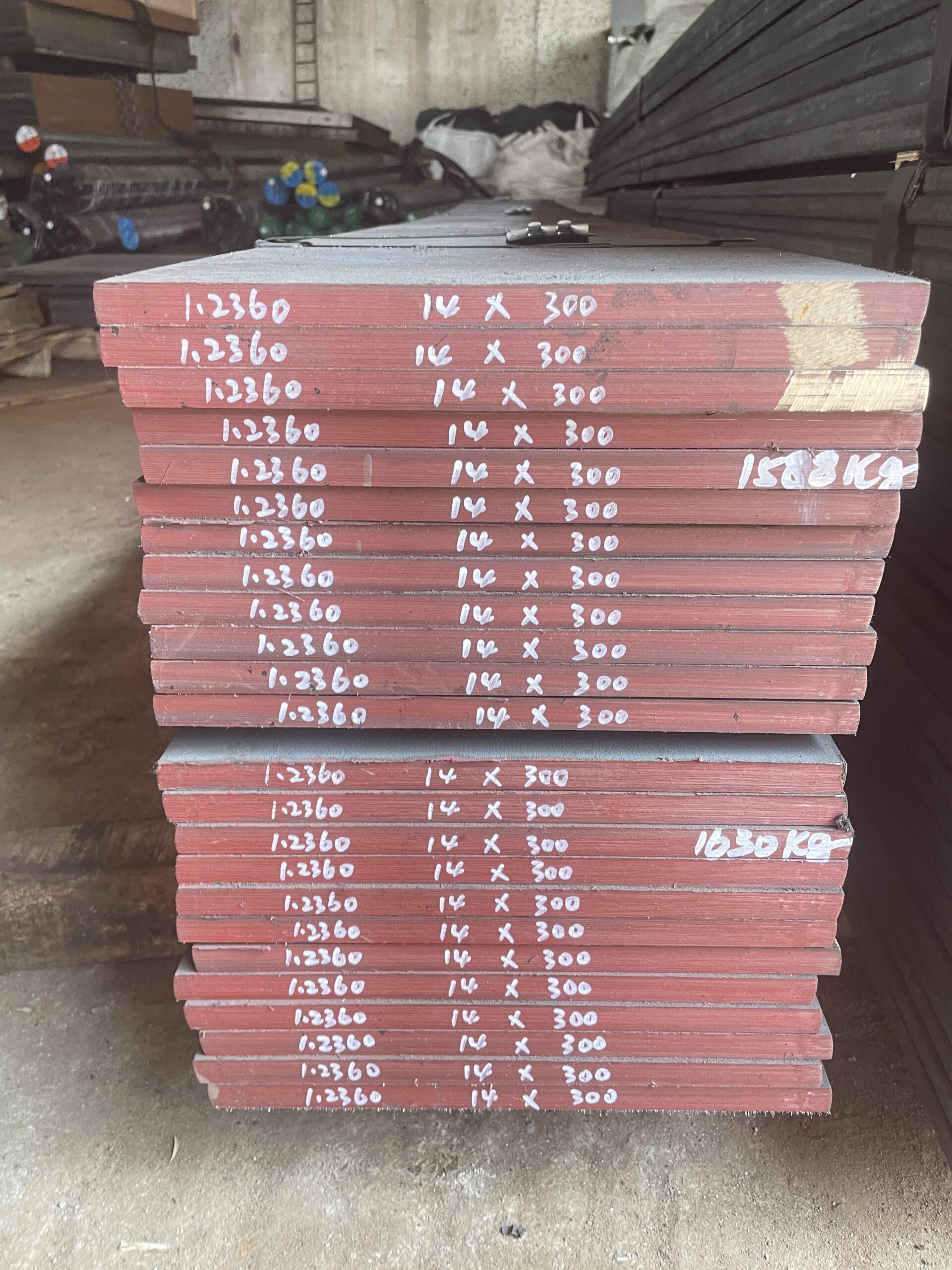
Choosing the wrong tool steel leads to early failure. Two grades we often compare are  A8 Modified/1.2360  and  D2. Both are air-hardening, but they solve different problems. A8 modified chipper steel equivalent 1.2360.

Composition Difference between A8 Modified/1.2360 and D2

C Si Mn S P  Cr Mo  Ni  V
D2 1.40-1.60 0.10-0.60 0.10-0.60 Max0.030 Max0.030 11.00-13.00 0.70-1.20 / 0.50-1.10
A8 modified/ 1.2360 0.45-0.50 0.70-0.90 0.35-0.45 Max0.005 Max0.020 7.30-7.80 1.30-1.50 / 1.30-1.50

– D2 : High carbon (1.4–1.6%) and high chromium (11–13%). This creates hard carbides for excellent wear resistance.
– A8 Modified/1.2360: Medium carbon (0.45–0.50%) and medium chromium (7.3–7.8%). It adds molybdenum, vanadium for superior toughness.

D2 platePerformance: Wear Resistance vs. Toughness

This is the key trade-off.

– D2: Offers high wear and abrasion resistance . It holds a sharp edge for long production runs. However, it is brittle and prone to chipping or cracking under impact.
-A8 Modified /1.2360: Offers excellent impact toughness. It resists shock, bending, and breaking. The trade-off? Lower wear resistance than D2.

 Application Range

Choose D2 when failure is from wear:

– Long-run blanking dies
– Forming rolls
– Slitter and shear blades
– Thread rolling dies

Choose A8 Modified /1.2360 when failure is from chipping or breaking:

– Cold heading punches
– Cold forging dies
– Heavy-duty stamping punches
– Chipper knives (wood/paper)
– Punches that see impact loads

Price Comparison

– D2: More affordable. It is a standard, high-volume grade with competitive pricing.
– A8 Modified/1.2360: Higher cost per kg due to its specialized alloy design and lower production volume.

But remember: If your D2 tools keep cracking, the downtime and replacement cost far exceed the material price difference. A8 Modified /1.2360 often gives a lower total cost per part.A8 MODIFIED/1.2360 flat bar

 Summary Table

Feature D2 A8 Modified
Wear Resistance High Medium
Toughness Low-Medium High
Typical Hardness (HRC) 58–62 56–60
Price Lower Higher
Failure Mode Solved Abrasion Impact / Cracking

D2 narrow flat bar

Our Recommendation for Export Customers

– Wear life is your problem → Choose D2
– Cracking or breaking is your problem → Choose A8 Modified/1.2360

We stock both grades in rounds, flats, and plates. Not sure which one fits your application? Send us your tool drawing and failure photos. We will recommend the right steel for your real shop-floor conditions.

Contact us today for a quote on D2 or A8 Modified/1.2360 steel.


Joann
Name: Joann


0 Continue Reading →

4140 steel: an excellent choice for aviation and automation

4140 steel – an all-rounder with excellent performance

4140 steel and it’s equivalent steel  chemical  composition :

Grade C Si Mn S P  Cr Mo  Ni  V W
4140 0.38-0.43 0.15-0.35 0.75-1.00 ≤0.040 ≤0.035 0.80-1.10 0.15-0.25 / / /
EN19 0.36-0.44 0.10-0.40 0.70-1.00 ≤0.040 ≤0.035 0.90-1.20 0.15-0.25 / / /
42CRMo 0.38-0.45 0.17-0.37 0.50-0.80 ≤0.035 ≤0.035 0.90-1.20 0.15-0.25 / / /
42CRMo4 0.38-0.45 ≤0.40 0.60-0.90 ≤0.035 ≤0.025 0.90-1.20 0.15-0.30 / / /
SCM440 0.38-0.43 0.15-0.35 0.60-0.85 ≤0.030 ≤0.030 0.90-1.20 0.15-0.30 / / /


The exquisite combination of these elements gives 4140 steel the perfect blend of high strength and toughness.

After quenching and tempering, it exhibits excellent comprehensive mechanical properties,

  • Tensile Strength: Typically Min  1080 MPa
  • Yield Strength: Min 930 MPa
  • Area Reduction: Min 45%
  • Impact energy :Min 63J
  • Impact toughness value: Min 78J/cm²
  • Hardness: 28-32HRC

Not only that, the addition of molybdenum and chromium significantly improves its wear resistance and fatigue resistance, allowing it to maintain stable performance under repeated stress conditions. At the same time, 4140 steel also has excellent machinability, easy cutting and forming, and good heat treatment responsiveness. It can accurately adjust the hardness and toughness through different heat treatment processes, such as normalizing, quenching + tempering(QT), to suit diverse applications. Application requirements have also enabled it to show its talents in many fields such as aerospace, automobiles, and machinery manufacturing.

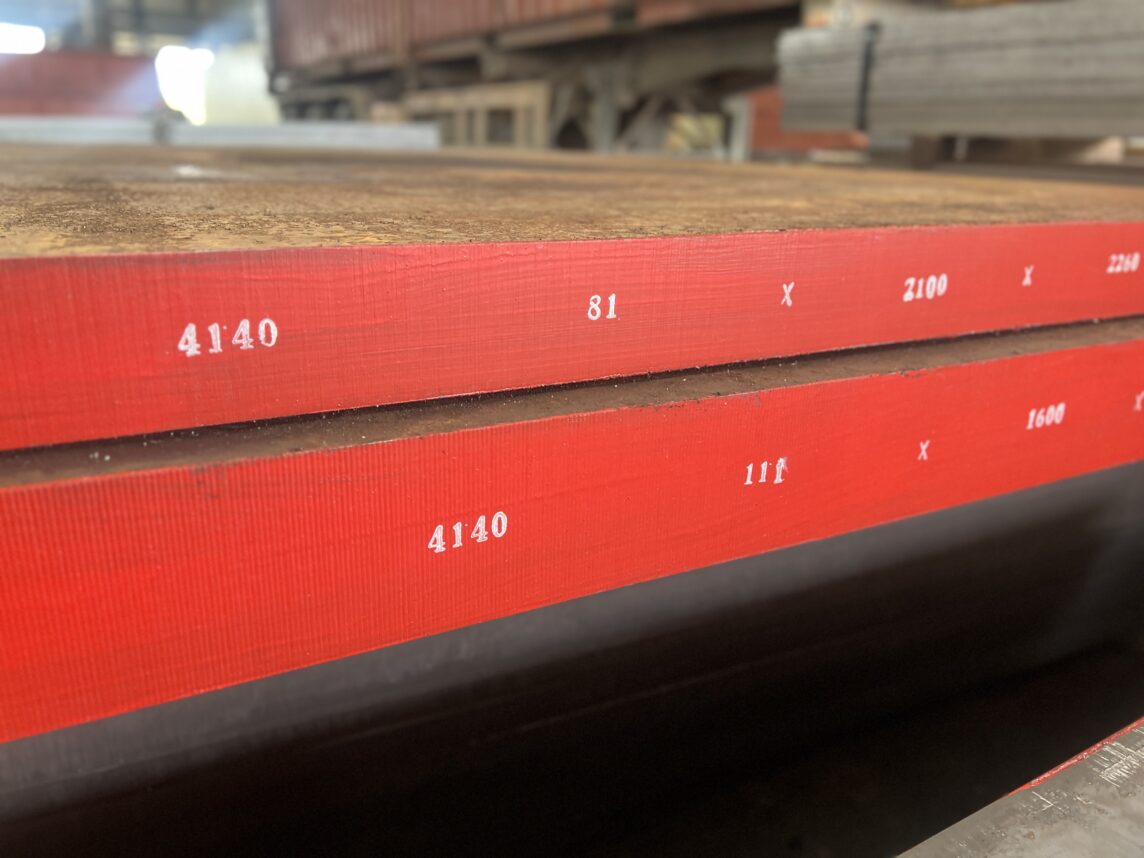
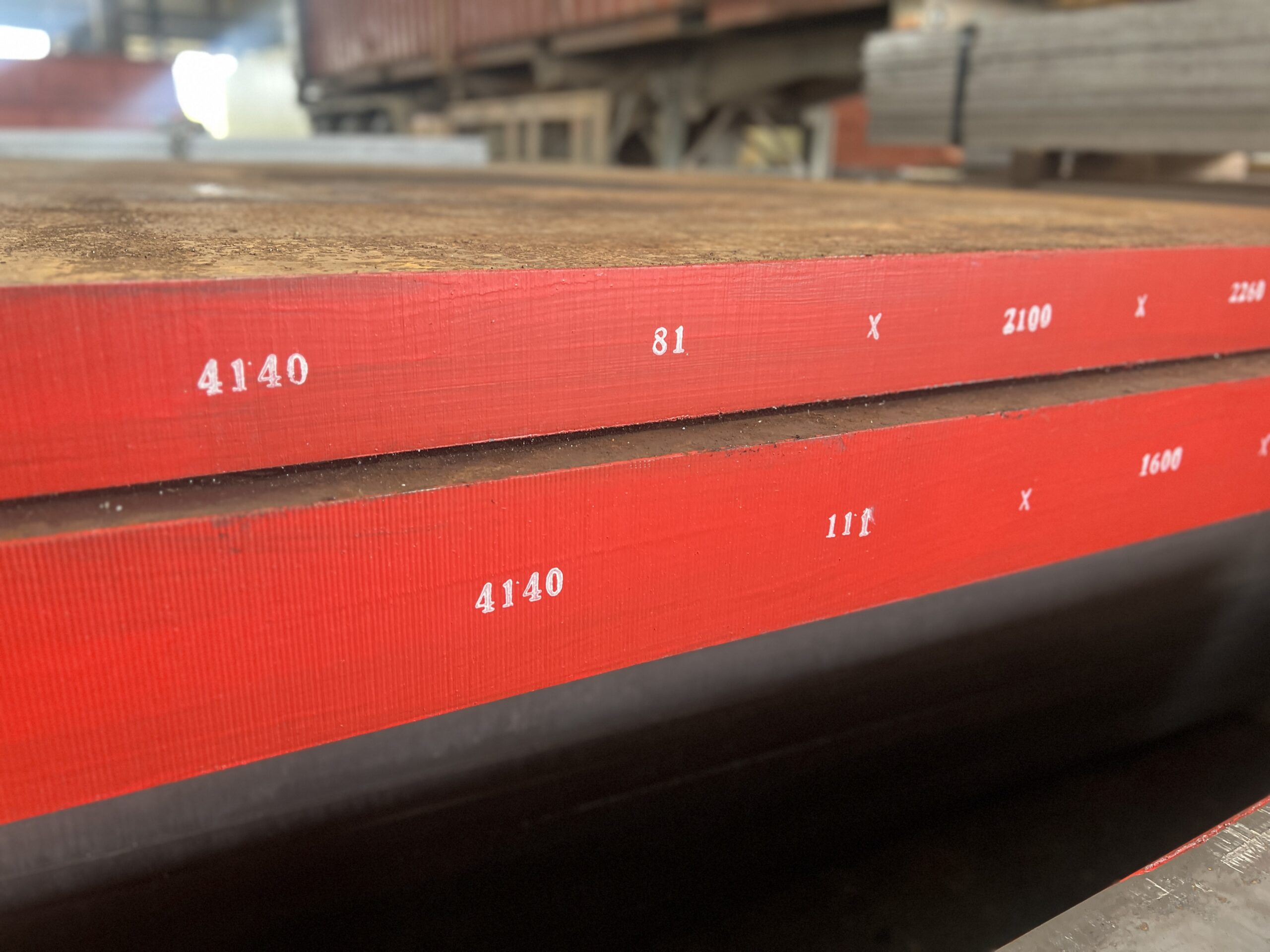
4140 steel plateThe “steel backbone” of the aviation field
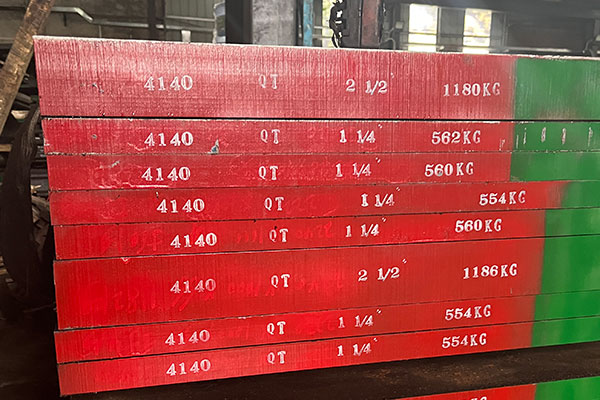
(1) Solid support of the landing gear

In the aerospace industry, 4140 steel is the unsung hero. As a key component for takeoff and landing, aircraft landing gear must withstand huge impact forces and heavy loads. After proper heat treatment, 4140 steel has a tensile strength of over 1500MPa and a yield strength of over 1300MPa, making it easy to handle. Like the Boeing 737 series aircraft, some key parts of the landing gear are made of 4140 steel. The impact force at the moment of landing can reach hundreds of tons. With its high strength, good toughness and hardenability, it ensures the structural integrity of the landing gear and allows the aircraft to touch the ground smoothly. Glide safely.

(2) Responsible for the stability of the fuselage structure

The fuselage structure is also inseparable from 4140 steel. When flying in the air, the fuselage is subjected to complex stresses, including air pressure differences, torque from maneuvering flight, etc. 4140 steel is used in key parts such as fuselage beams and frames. It has excellent fatigue resistance and can withstand millions of stress cycles without crack initiation. At the same time, compared with some high-strength but high-density steels, it has a suitable strength-to-weight ratio, which can reduce weight while ensuring the stability of the fuselage, improve fuel efficiency, help the aircraft have longer range and better economy, and provide benefits to the aviation industry. Development has made great contributions.

 “Right-hand assistant” in the field of automation

(1) The first choice for precision mechanical parts

In the field of automated production, 4140 steel is also a “powerful candidate”. It is the best choice for manufacturing precision mechanical parts, such as high-precision gears, shafts, etc. Its good machinability allows it to easily achieve micron-level processing accuracy during turning, milling, grinding and other processing processes, meeting the stringent requirements of automation equipment for precision fit of parts. Moreover, through proper heat treatment, the hardness can be controlled in the HRC 30-40 range, which not only ensures high strength but also takes into account toughness, allowing parts to stably transmit power under high-speed operation and frequent starts and stops, and reduce the risk of wear and fatigue failure. , greatly improving the operational reliability and lifespan of automated production lines.

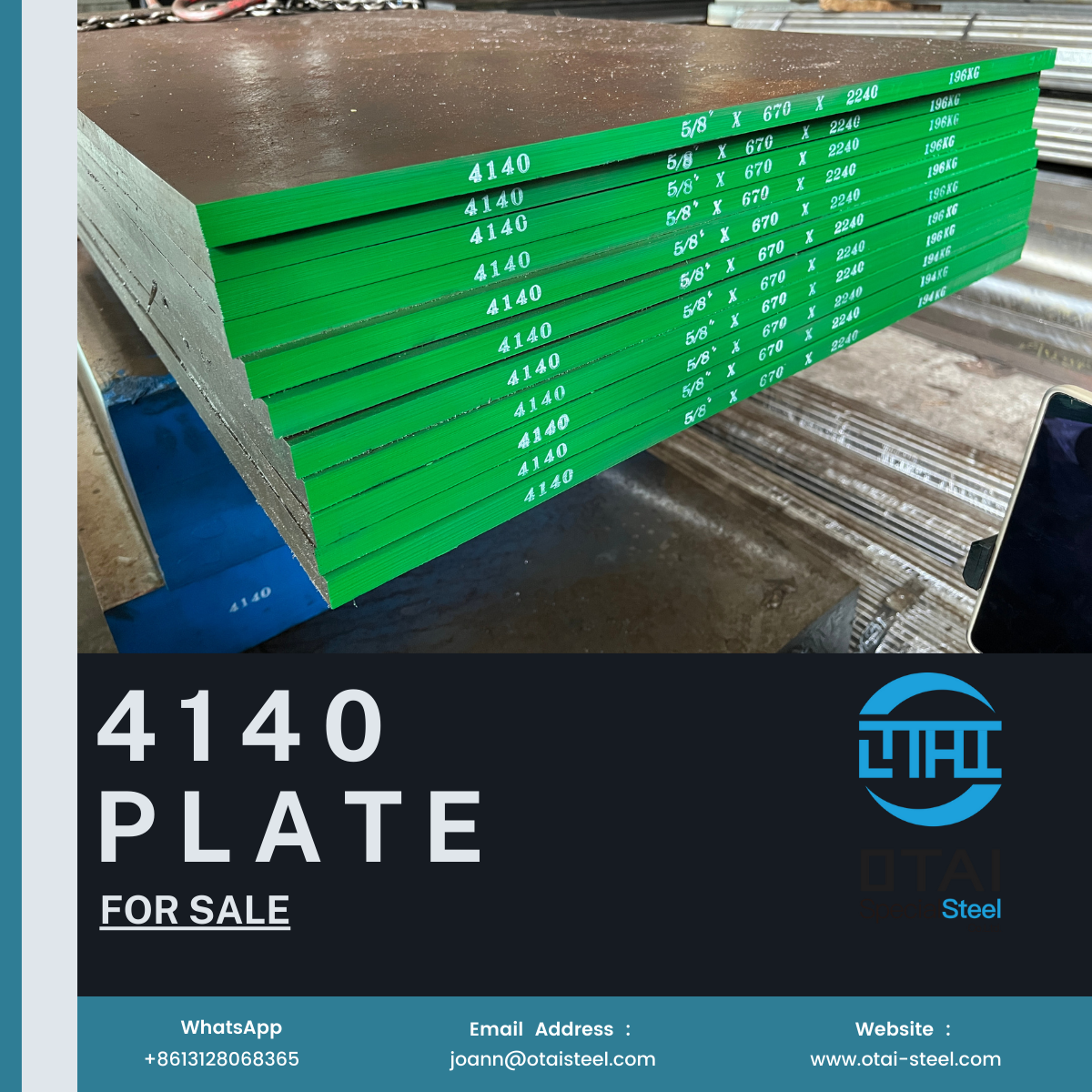
(2) Reliable guarantee of industrial automation equipment4140-steel-plate

4140 steel is often found in key parts such as frames and guide rails of industrial automation equipment. When the equipment is running, the frame must bear the weight of many components and resist vibrations, and the guide rails must ensure that the slider moves smoothly and accurately. With its excellent wear resistance, 4140 steel can still maintain dimensional accuracy after long-term use, reducing the risk of equipment accuracy drift; its excellent anti-fatigue performance can withstand millions of stress cycles, eliminate cracks, and ensure the stability of equipment for many years. operation, greatly reducing the company’s downtime maintenance costs caused by equipment failure, and laying a solid foundation for the efficient advancement of automated production.

Professional steel supply and quality assurance

As a professional supplier specializing in 4140 steel, we feel a heavy responsibility. In terms of quality control, from the strict screening of raw material procurement, to the precise control of every step of the production process, to the comprehensive inspection of finished products before leaving the factory, we ensure that every batch of 4140 steel meets or even exceeds industry standards. Whether it is tensile strength, yield strength, hardness, toughness and other key indicators, there are detailed data to support the quality.

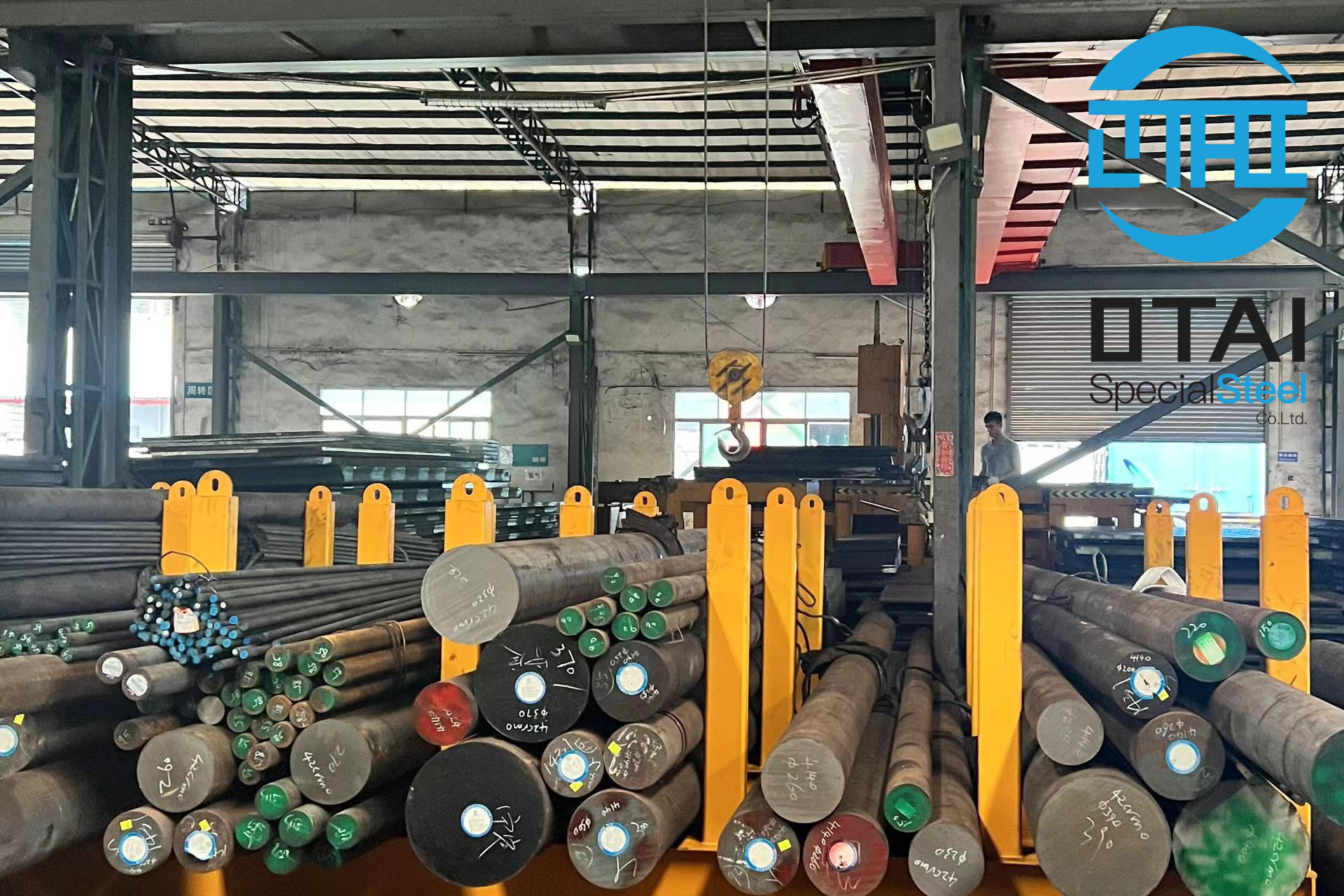
In terms of inventory, we always have a wide range of 4140 steel in stock, covering round bars of different diameters, plates of various thicknesses, and profiles of various sizes to meet the diverse needs of customers. Whether you are in small batch trial production or large-scale production, we can quickly Respond to supply.

4140 round bar

Not only that, we also provide customized services, tailor-made exclusive material solutions based on customers’ special composition fine-tuning and heat treatment requirements for steel; our after-sales team is on standby to answer your questions during use and solve technical problems, making your purchase smooth. worry. Choosing us means choosing professionalism, reliability and peace of mind, and working together to create a brilliant future.


Joann
Name: Joann


0 Continue Reading →

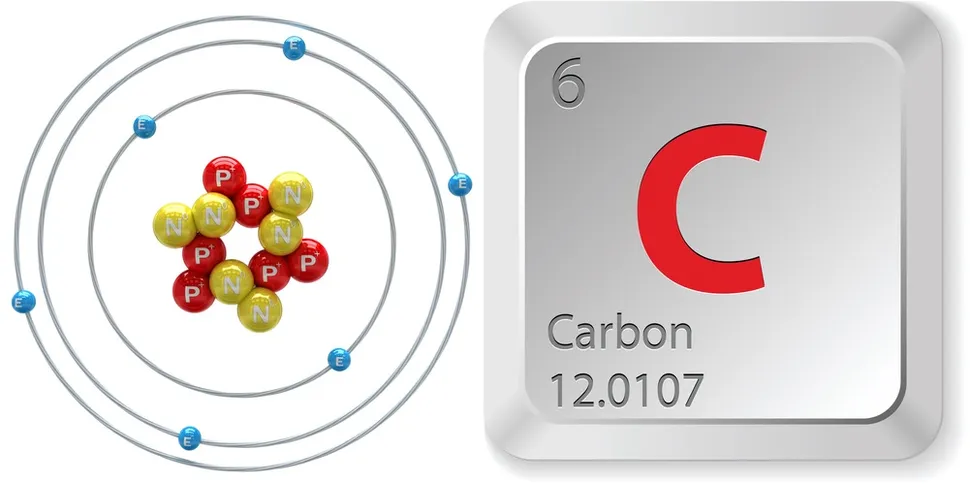
Effect of Carbon on Steel Properties

Carbon element plays a key role in balancing strength and toughness in steel. Reasonable control of carbon content is a core link in steel design and production. The higher the carbon content, the higher the hardness of the steel, but the worse its plasticity and toughness. When the carbon content exceeds 0.23%, the welding performance of the steel deteriorates. Therefore, the carbon content of low-alloy structural steel used for welding generally does not exceed 0.20%. High carbon content will also reduce the atmospheric corrosion resistance of steel, and high-carbon steel in open-air stockyards will easily rust. In addition, carbon can increase the cold brittleness and aging sensitivity of steel.

Carbon exists in two forms in steel. One is free state, such as iron-carbon solid, amorphous carbon, annealed carbon, graphite carbon, etc., which can be directly represented by “C”. The other is combined carbon, that is, carbide of alloy elements, such as Fe3C, Mn3C, etc., which can be represented by “Mc”. The former generally cannot react with acid, while acid can dissolve and destroy the latter. In steel, combined carbon is the main form, and free carbon only exists in iron and annealed high-carbon steel. In component analysis, usually measurethe total carbon content .

carbon steelThe specific role of carbon element in steel:
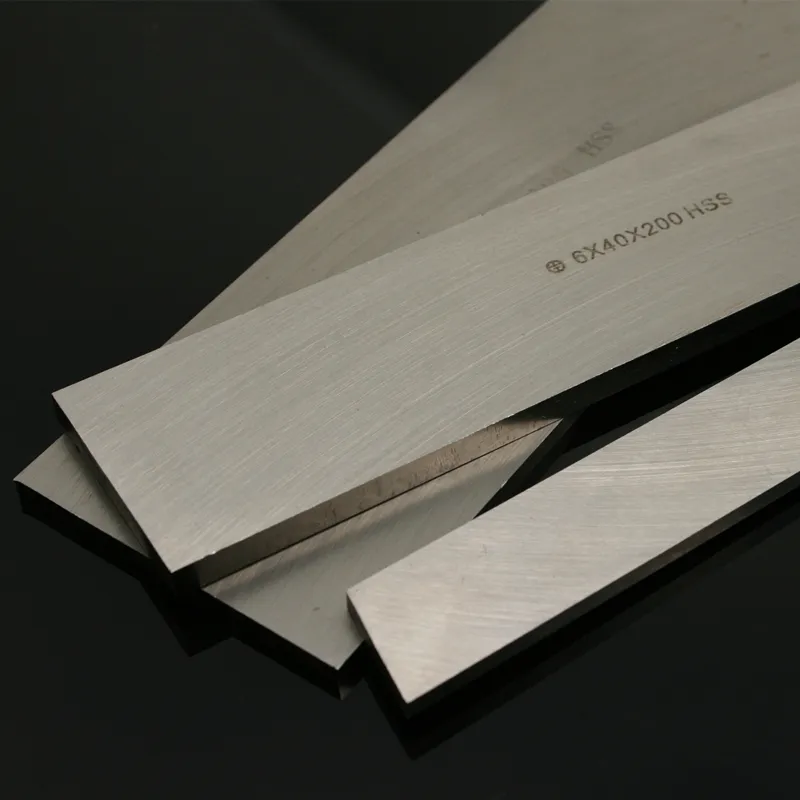
Effect on the microstructure of steel:  The carbon content determines the microstructure of the steel, such as the proportion of pearlite, bainite or martensite, which in turn affects the overall performance of the steel.

Effect of heat treatment on steel Hardenability:  Steel with high carbon content is more likely to form martensite during heat treatment (such as quenching), significantly increasing the hardness. Carbon also affects the phase transformation temperature and hardenability of steel, which determines the final properties of the steel after heat treatment.

Effect on the mechanical properties of steel Enhanced strength and hardness: Increased carbon content will significantly increase the strength and hardness of steel. This is because carbon atoms form carbides (such as Fe3C) in the iron lattice, which enhances the steel’s ability to resist deformation.

Reduced ductility and toughness: Although carbon increases strength and hardness, too high a carbon content can reduce the ductility and toughness of steel, making it more susceptible to brittle fracture.

In the past few articles, we also analyzed the role of Cr in steel and the relationship between Ni and steel. If you are interested, you can take a look.


Joann
Name: Joann


0 Continue Reading →

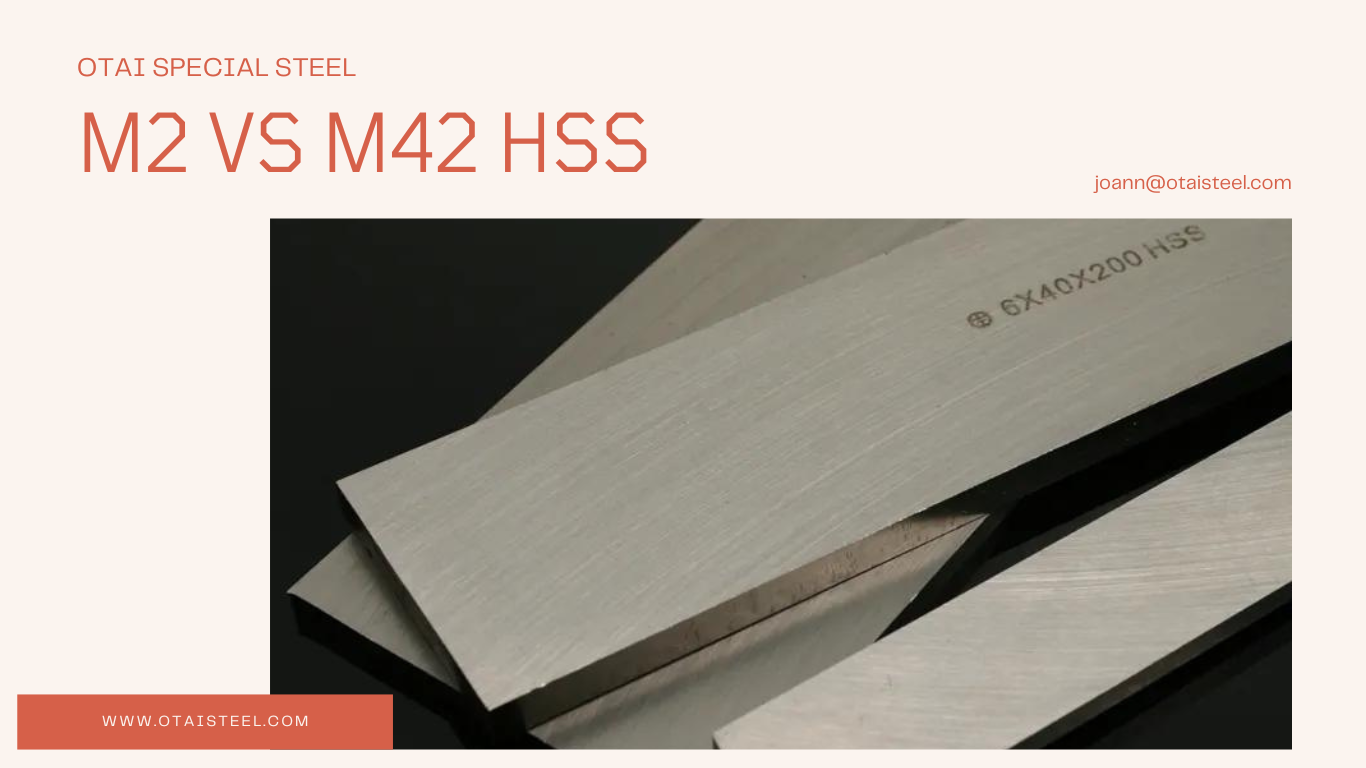
What’s the difference with M2 and M42 high speed steel?

High-speed steel is a high-alloy steel containing large amounts of carbon (C), tungsten (W), molybdenum (Mo), chromium (Cr), vanadium (V) and other elements. It has high  hardness after heat treatment. When the cutting temperature reaches over 600°C, the hardness does not drop significantly, and the cutting speed of tools made with it can reach 60m/min, hence the name high-speed steel.

M2 is a molybdenum series high-speed steel, which is mostly used to make tools for cutting difficult materials.
M42 is a high-cobalt toughness high-speed steel, mainly used for high-toughness precision wear-resistant hardware cold stamping dies

Both steel have the good toughness , wear-resistance and hardness . But it have some difference between it’s application area , properties and cost . This article mainly compares the differences details between M2 vs M42 steel.

Chemical composition M2 vs M42 steel

  C Si Mn S P  Cr Mo  V W Co
M2 0.78-0.88 0.20-0.45 0.15-0.40 ≤0.030 ≤0.030 3.75-4.50 4.50-5.50 1.75-2.20 5.50-6.75 /
M42 1.05-1.15 0.15-0.65 0.15-0.40 ≤0.030 ≤0.030 3.50-4.20 9.00-10.00 0.95-1.35 1.15-1.85 7.75-8.75

Cr is approximately 4% in almost all high-speed steels.

And the biggest difference between M2 and M42 steel is the content of Cobat(Co) and Molybdeum(Mo) and Tungsten(W). Mo and W have a similar effect on the properties of steel. Meanwhile , both Mo and  W are  the most important composition which imporve the toughness of steel . However, since Mo is much more expensive than W, in order to consider the cost in the production of high-speed steel, W is used in most cases, and then Mo is used to replace part of W to improve toughness. This is tungsten Molybdenum high speed steel, like M2, M4, SKH51, SKH55, etc.  All belong to tungsten-molybdenum high-speed steel, and tungsten-molybdenum high-speed steel has a higher overall cost performance.

M2 knivesBut there is another element that has a more significant effect on improving hardness than Mo and W,  that is Co. Co does not produce carbides with carbon, but it will dissolve in the steel, greatly improving the hardness of the steel. It is precisely because of the importance of Co that high-speed steel can be directly divided into two categories, cobalt-containing high-speed steel and cobalt-free high-speed steel. The reason is that Co can significantly improve the red hardness of steel, thereby improving the wear resistance of high-speed steel at high temperatures.
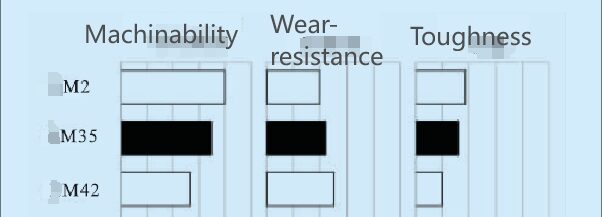
Performance difference M2 vs M42 steel

Hardness :

M2 This steel is easy to heat treat, has little decarburization after heat treatment, and can achieve the maximum  Rockwell hardness is HRC65

M42  can be heat treated to a higher hardness (HRC65-67) than any other high-speed steel and achieve the highest level of  hardness.

Wear-resistance:

The addition of Co composition makes M42 much more better wear-resistant than M2.

Toughness

As for toughness, M2 already has very good toughness, but because the Mo content is much higher than M2, M42 has the highest toughness among high-speed steels.

M2 VS M42Application difference M2 vs M42 steel
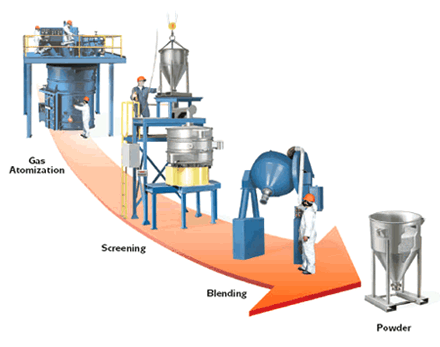
M2 tool steel is the most commonly used high-speed steel.  This steel is easy to heat treat, has little decarburization after heat treatment,  which is mainly used for cutting tools and is suitable for processing under high-speed and high-temperature conditions.

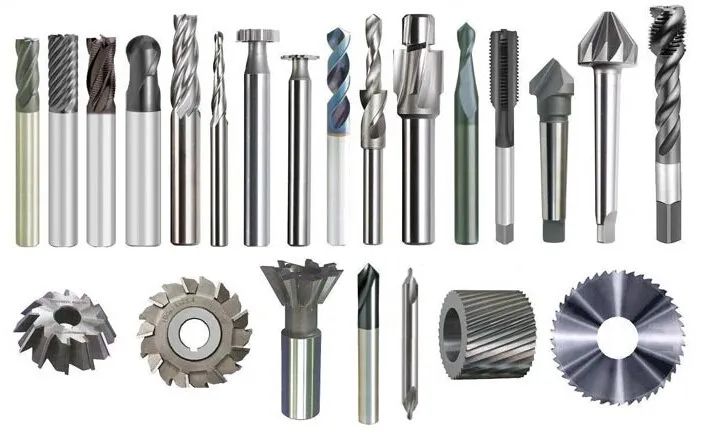
Applications of M2 : drills, reamers, taps, gear cutters, lathe tools, broaches, boring tools, punches, milling cutters, etc.

M42 CNC punches

M42 tool steel adds 7.75%-8.75% cobalt to increase hardness and toughness. At the same time, the addition of cobalt can produce sharper cutting edges and extend tool service life.

Because of this, M42 tool steel is also suitable for machining stainless steel, high hardness and difficult-to-machine alloys in heavy-duty and high-volume applications.

Applications of M42 : milling cutters, broaches, taps, drills, reamers, punches, saws, cutting tools and thread rolling dies.

Cost difference

M2 as a common ordinary high speed steel , the price is cheaper than M42. M42 add Co , more molybdenum. And  becasue of  China lacks cobalt resources, and cobalt high-speed steel like M42 is expensive 5-8 times than  ordinary high-speed steel.

In Conclusion

The main difference between M2 vs M42 is the different alloy composition ratios. M42 has a more complex process and a higher price. Relatively speaking, M42 has higher mechanical performance indicators, better hardness, wear resistance, and impact resistance. . However, M2 is a relatively cost-effective high-speed steel.  If the budget is limited and the performance requirements are not very high, people can choose M2.

0 Continue Reading →

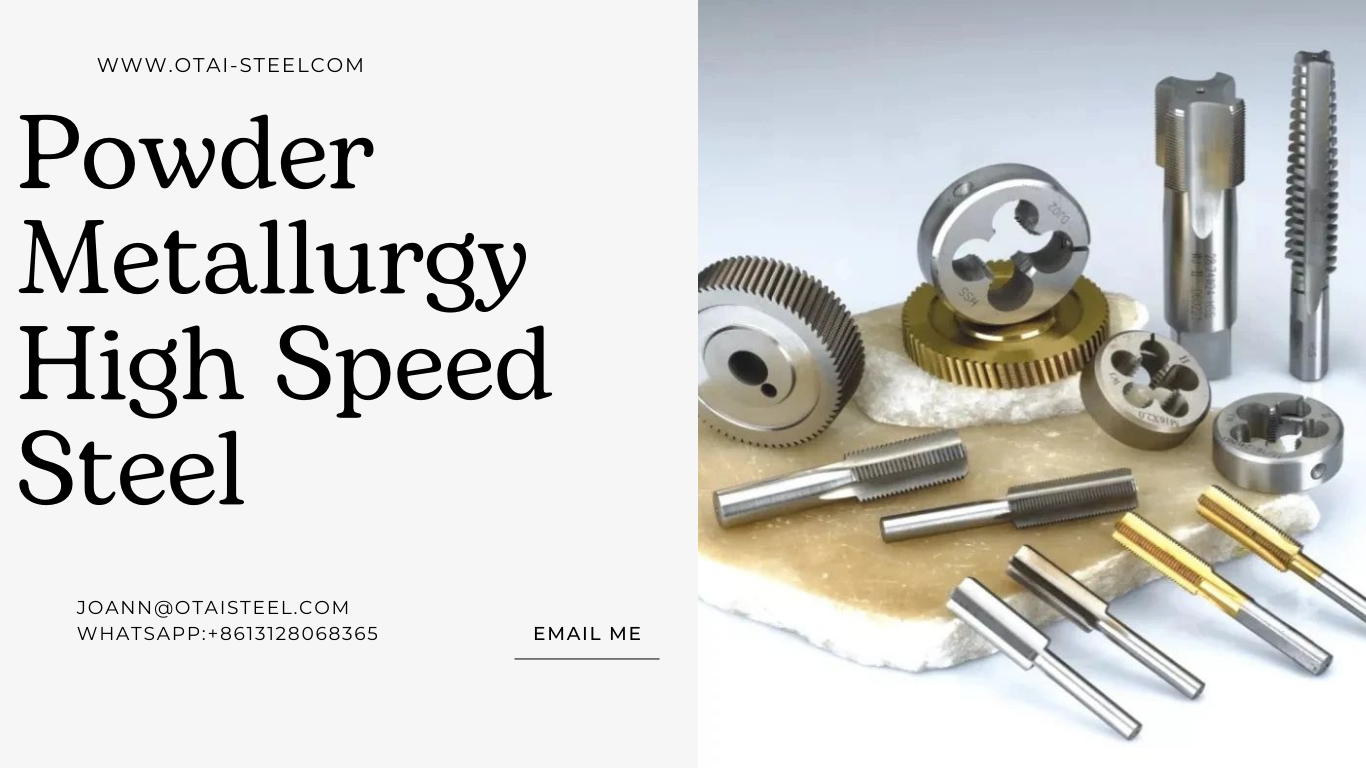
What is Powder metallurgy high-speed steel (PMHSS) ?- TPM330, ASP23,M3:2

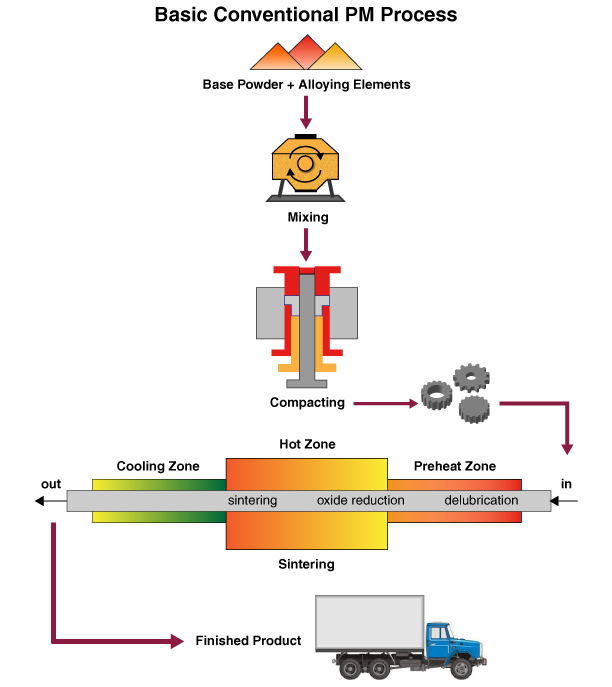
Before understanding powder high-speed steel, we first understand what powder metallurgy is. Powder metallurgy refers to a steel manufacturing process in which fine steel powder is obtained by atomizing molten steel with high-pressure inert gas or high-pressure water, then pressed into shape under high temperature and high pressure, and then sintered. Powder metallurgy high-speed steel also call PMHSS which  is high-speed steel manufactured through powder metallurgy process.

Manufacturing process of Powder metallurgy high speed(PMHSS)

    1. Atomized high-speed steel: First, pour the high-speed steel into high-pressure inert gas or high-pressure water to atomize it into fine high-speed steel powder.PMHSS process-Powder process
    2. Press molding:Put the high-speed steel powder obtained after atomization into a mold and press it into shape under high temperature and high pressure.
    3. Sintering: Put the pressed blank into a sintering furnace and perform sintering treatment to make it completely densified.
    4. Heat treatment: Finally, the sintered blank make heat treatment to adjust its structure and properties.powder metallurgy high speed steel process

The difference between Powder metallurgy high speed(PMHSS)and traditional HSS

Wear resistance

Since the particles (powder) of PMHSS are small and uniform, there will be no uneven solidification, and the internal structure is uniform and stable. Therefore, under the same heat treatment and quenching temperature, the wear resistance of PMHSS will be better than  ordinary HSS.

Purity

Before PMHSS is prepared and formed, its raw materials (powder) will be strictly filtered and screened. This will completely remove impurities and non-metallic substances from the raw material. At the same time, the composition of PMHSS is stabilized after molding to ensure product quality.

No directionality

Powder metallurgy high-speed steel(PMHSS) is made of extremely small particles (powder) that are pressed and sintered, so the performance and strength of all parts of the entire product will be the same. There will be no horizontal or vertical organizational structure like ordinary high-speed steel. Therefore, the overall performance of the entire product also be higher.

Regular deformation

Although powdered high-speed steel has a special structure, dimensional deformation will also occur during the heat treatment process. However, compared with the irregular deformation of ordinary high-speed steel, PMHSS will cause regular deformation of the entire product. In other words, during the heat treatment process of grinding high-speed steel, all parts will become larger at the same time.

Difference in price

The production process of powder metallurgy high-speed steel is complex and the cost is high.

PMHSS is generally 4 to 8 times more expensive than ordinary high-speed steel, so it is usually used to manufacture precision and complex tools or tools for CNC machine tools.

However, the performance of cutting tools made of PMHSS is better than that of ordinary HSS, and the service life is longer than that of ordinary HSS (generally 2 to 3 times).

Application of Powder metallurgy high speed (PMHSS)

  • Powder metallurgy high speed steel has good mechanical properties. Suitable for manufacturing: tools that are prone to chipping under intermittent cutting conditions, tools with high strength and sharp cutting edges. Such as gear shaper cutters, hobs, milling cutters, and tools used under high-pressure dynamic loads.
  • It has small carbide segregation, fine grains and good wear resistance. Suitable for manufacturing: large-size knives, precision knives, complex knives.
  • This type of material has high thermal hardness at high temperatures and is suitable for making tools for difficult-to-machine materials. It is indeed comprehensive.PMHSS application

The development of Powder metallurgy high speed in China

Although China is a major producer of high-speed steel cutting tools, with output and export volume ranking first in the world, China’s high-speed steel industry is still limited by technical barriers and other factors. Currently, the high-end high-speed steel market is still monopolized by overseas brands. At present, most of the powdered metallurgy high-speed steel (PMHSS) is still imported into China.

Due to the high price, many users cannot afford the high cost. In recent years, China has also begun to develop Chinese powder high-speed steel, such as TG’s TPM330. The following is a comparison of the chemical composition of TPM330 with ASP23 and M3-2

C  Cr Mo  V W Si Mn S P
M3-2 1.15-1.25 3.75-4.50 4.75-6.50 2.75-3.25 5.00-6.75 0.20-0.45 0.15-0.40 Max 0.030 Max 0.030
ASP23 1.28 4.20 5.00 3.10 6.40
TPM330 1.28 4.10 5.00 3.00 6.40

Although China’s TPM330 cannot completely replace ASP23 at present, it is undoubtedly the most cost-effective choice. Under the use conditions of some punch materials, the national standard TPM330 also has a longer service life and better performance than ordinary ones such as M2, M42, and DC53. However, for IC packaging molds and complex-shaped workpieces, you can only choose ASP23 because the purity cannot reach  TG. TG is the third generation of powder metallurgy, and ASP is the fifth generation.


In conclusion

The special and advanced smelting method of PMHSS is an innovation in high-speed steel smelting, which creates a new steel type with properties between cemented carbide and ordinary HSS. The rise of PMHSS has brought new breakthroughs in tool materials for the machinery manufacturing and processing industry. As a new steel type with excellent performance, it has gradually been recognized, accepted and loved by people, and is playing an increasingly important role in the machinery industry.

In short, PMHSS is a very excellent high-performance steel with fine grain structure, high wear resistance, high toughness and other characteristics. And is suitable for high-precision and high-efficiency processing applications.

It can be used not only to manufacture various types of tools and cutters, but also to manufacture high-quality mechanical parts and bearings, etc. In the future, with the continuous development of powder metallurgy technology, it is believed that the application scope of  PMHSS will be further expanded.

Currently , Otai stock PMHSS  TPM330 flat bar size

150*200/ 150*300 /200*200 /200*300

If you want to know more about the PMHSS information and the TPM330 stock , please contact

0 Continue Reading →

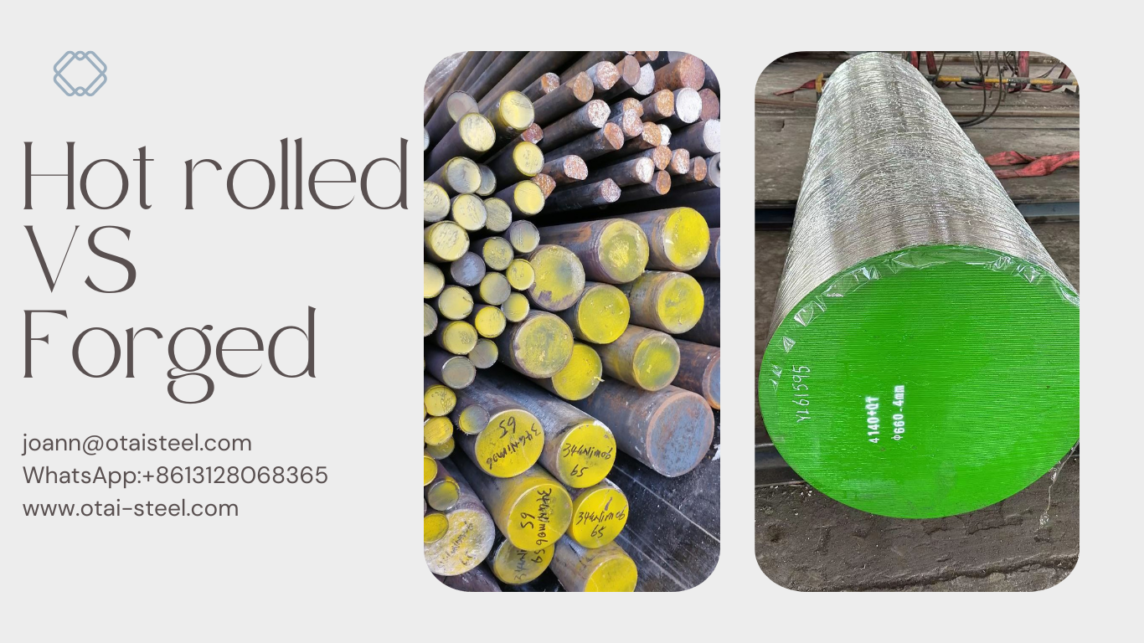
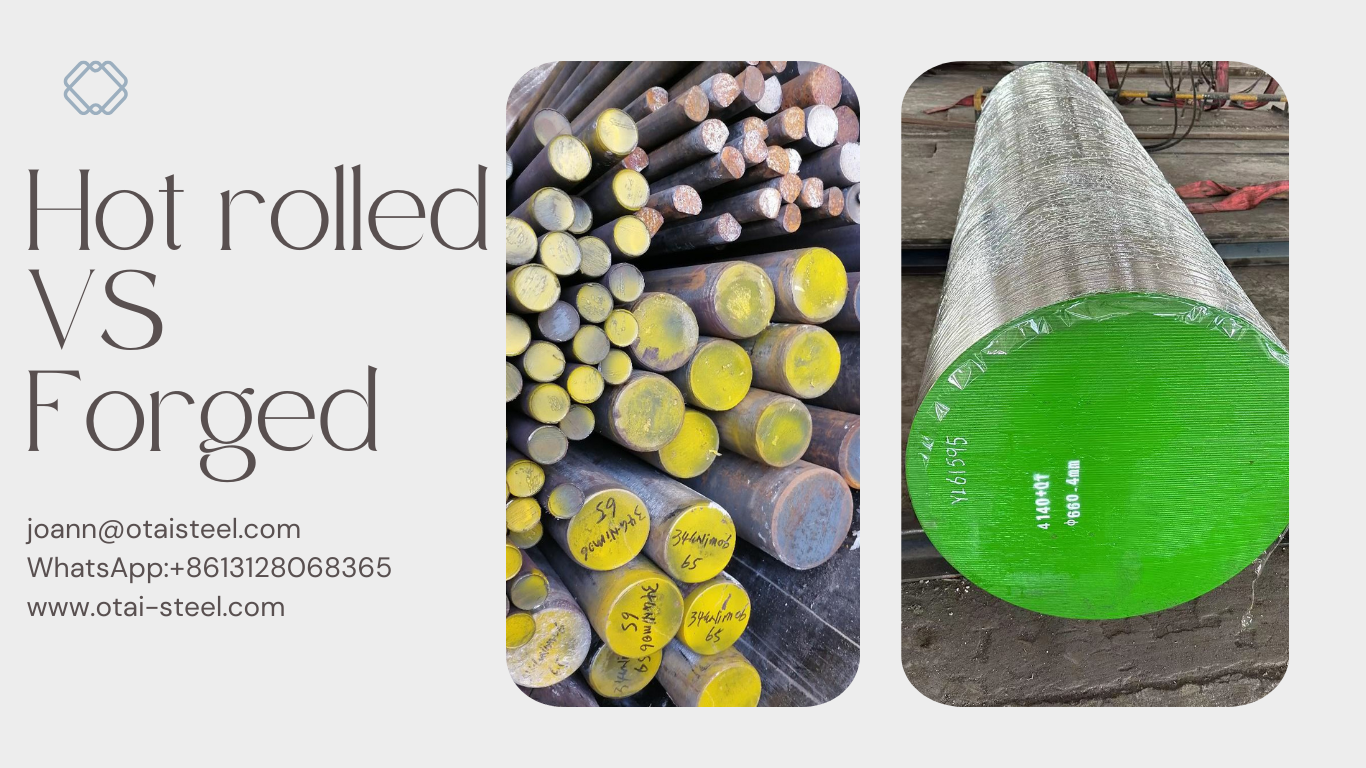
The difference with Hot rolled and Forged

Hot rolled and forged are two normal process method for steel .

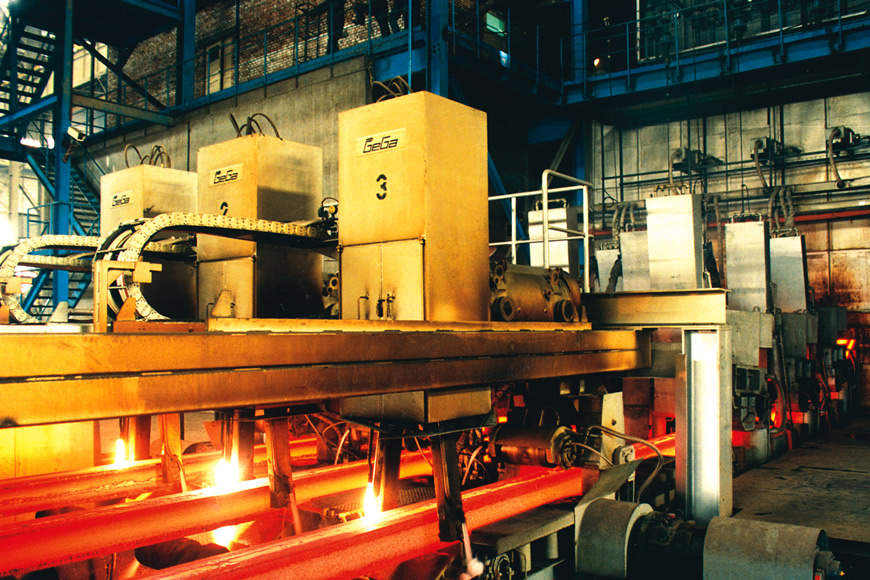
What is hot rolling:

The metal blank is passed through the gap between a pair of rotating rollers (in various shapes). Due to the compression of the rollers, the cross section of the material is reduced and the length is increased. This is the most common production method for producing steel. It is mainly used to produce profiles, Plates and pipes. At present, the most common one is continuous casting and rolled.

continue rolling and continue castingAdvantages of hot rolled

It can destroy the casting structure of the steel ingot, refine the grains of the steel, and eliminate defects in the microstructure, thereby making the steel structure dense and improving the mechanical properties. This improvement is mainly reflected in the rolled direction, so that the steel is no longer isotropic to a certain extent; bubbles, cracks and looseness formed during pouring can also be welded under high temperature and pressure.

Disadvantages of hot rolled

  • After rolled, the non-metallic inclusions (mainly sulfides, oxides, and silicates) inside the steel are pressed into thin sheets, resulting in delamination (sandwiching). Delamination greatly deteriorates the tensile properties of the steel along the thickness direction and may cause interlaminar tearing as the weld shrinks. The local strain induced by weld shrinkage often reaches several times the yield point strain, which is much larger than the strain caused by load.
  • Residual stress caused by uneven cooling. Residual stress is the internal self-balanced stress in the absence of external force. Hot-rolled steel sections of various sections have such residual stress. Generally, the larger the cross-section size of the section steel, the greater the residual stress. Although residual stress is self-balanced, it still has a certain impact on the performance of steel components under the action of external forces. For example, it may have adverse effects on deformation, stability, fatigue resistance, etc.
  • Hot-rolled steel products are difficult to control in terms of thickness and edge width. We are familiar with thermal expansion and contraction. Even if the length and thickness are up to standard after hot rolled at the beginning, there will still be a certain negative difference after cooling. The wider the side width and the thicker the thickness, the more obvious this negative difference will be. Therefore, for large-sized steel, the side width, thickness, length, angle, and edge lines of the steel cannot be too precise.

What is forged:

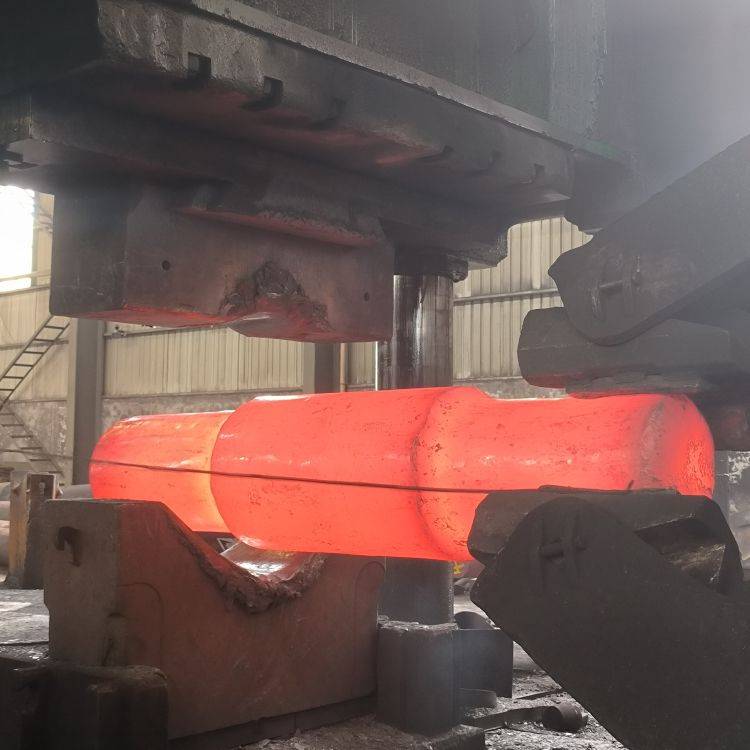
It is a processing method that uses forged machinery to exert pressure on metal blanks to cause plastic deformation to obtain forgings with certain mechanical properties, shapes and sizes. It is one of the two major components of forged (forging and stamping).

Forging can eliminate defects such as loose as-cast metal produced during the smelting process and optimize the microstructure. At the same time, due to the preservation of complete metal streamlines, the mechanical properties of forged are generally better than castings of the same material. Important parts in related machinery with high loads and severe working conditions mostly use forged, except for simple shapes that can be rolled plates, profiles or welded parts.

Forged Advantages of forged

  • Changes in mechanical properties: Compared with forged and castings, metal can improve its organizational structure and mechanical properties after forged. After the casting structure is deformed by hot processing by the forged method, due to the deformation and recrystallization of the metal, the original coarse dendrites and columnar grains change into an equiaxed recrystallization structure with finer grains and uniform size, causing the original segregation and recrystallization in the steel ingot. The porosity, pores, slag inclusions, etc. are compacted and welded, and the structure becomes denser, improving the plasticity and mechanical properties of the metal.
  • Longer service life: In addition, the forging process can ensure the continuity of the metal fiber structure, so that the fiber structure of the forging is consistent with the shape of the forging, and the metal streamlines are complete, ensuring that the parts have good mechanical properties and long service life. Forgings produced by precision die forging, cold extrusion, warm extrusion and other processes

Disadvantages of forged

  • The surface is rough. After forging, the oxide layer is often easily formed on the surface of the steel and the parts are uneven, resulting in uneven surface appearance and large tolerances.
  • The cost is higher. Due to the relatively low production efficiency of forging processing and the relatively high performance requirements, the yield rate is lower than other methods, so the production cost is more expensive than ordinary processing methods.

Comparison between hot rolled and forged

  • Different processing methods: hot rolled is continuous production, formed by two-way pressure rolled, usually continuous casting and rolling; forged is discontinuous production, usually three-way stress
  • The organizational structure is different. The internal structure of forging is relatively denser, so there are relatively fewer porosity and shrinkage defects, so the strength and polishing performance are superior. Therefore, there is a difference in the use of forged and hot-rolled materials. For example: 1.2311, 718 forged plates, customers require etching treatment, and it is generally recommended that customers use forged materials because they are loose, shrinkage, and dense inside. sex is better
  • The appearance, size and tolerance are different. The hot-rolled appearance is smoother and more uniform, and the tolerance is smaller. The thickness tolerance of the rolled plate is about 0-2mm. The tolerance of the round steel is determined according to the size, but it is generally within 0-3mm; overall forged.Generally speaking, the surface is rough and the tolerance range is also large, generally 0-5mm.
  • The service life of the two is different, because the difference between the transverse and radial mechanical properties of forged is small, that is to say, the isotropy of forged is much higher than that of rolled parts, so the service life of forged is much longer higher than rolled products.
  • In terms of processing costs, the cost of forged is much higher than the cost of ho rolled. For some key parts, workpieces that bear large loads or impacts, workpieces with complex shapes or very strict requirements, the forging process must still be used. processed.

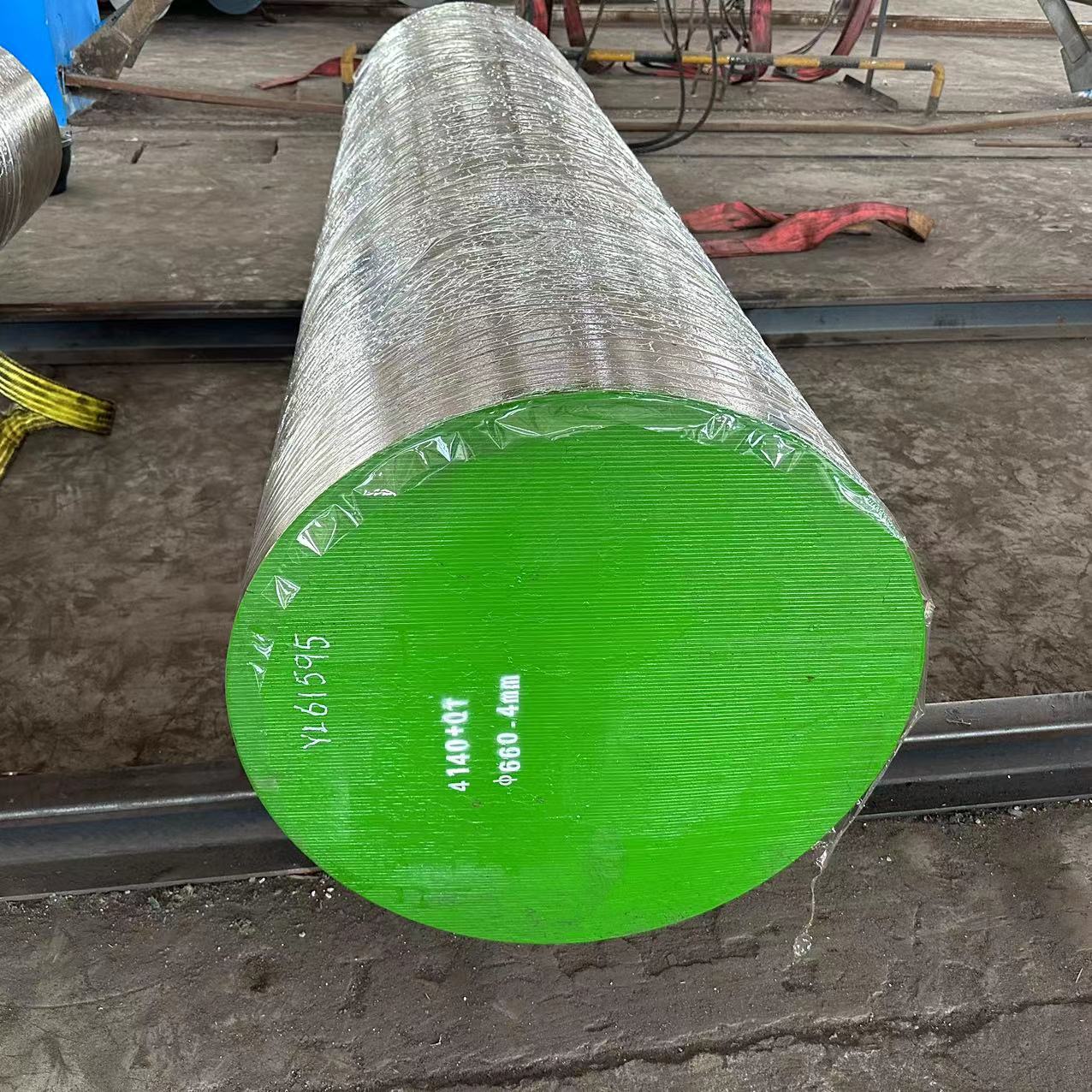
Forged 4140 round barHow to choose?

  •  Generally alloy steels such as 4140, 4340, 8620, carbon steels such as 1020, 1045, 1050, etc., with a diameter/thickness of 300mm or more are forged. If it is tool steel, such as 1.2379/D2, 1.2344/H13, O1/1.2550, etc., Diameter/thickness above 60mm are all forged. Choose forged or hot rolled according to the required size.
  •  If it is used in important mold parts or parts that bear greater impact, such as the mold core, you need to choose forged. However, if you need to control costs, you can choose hot-rolled materials in some less important parts, such as the mold frame.
  • Choose a suitable and stable supplier. A stable supplier can recommend the most suitable products to customers based on the uses and requirements of the products they need. Aotai Special Steel has been in the steel industry for more than 25 years and has professional product knowledge. Its inventory of 4140/42CrMo4 exceeds 3,000 tons and tool steel exceeds 1,000 tons. It also supplies stainless steel, high-speed steel, and carbon steel.
0 Continue Reading →


Recent Comments by Joann

    No comments by Joann